The Architecture of Attention: Lessons from the Recycling Bin
In the year 2000, when I moved from Rural Minnesota to Rural Wisconsin, my world was defined by what I could carry and what I could remember. I spent my days scavenging for parts in the electronic recycling bin of the Rural Wisconsin dump, trying to piece together computers from the discarded remnants of an industrial age. I learned early on that the human brain—even one like mine, optimized for high-functioning autism pattern recognition—has a finite Logical Bandwidth. When I was troubleshooting a fried motherboard, I couldn't hold every voltage point, every trace connector, and every possible failure node in my head at once. If I did, my internal system would experience a Total Logic Crash.
I had to "offload" my process. I used notebooks to map out circuits and polaroid photos to remember component placement. This was my first lesson in Cognitive Offloading: the strategic act of using external tools (like AI) to handle memory, processing, or routine logic. In 2026, we are faced with a far more aggressive challenge. Information Overload occurs when the volume of data we receive exceeds our cognitive capacity to process it. We are drowning in metadata, and without the ability to offload the trifecta of routine noise, we lose the capacity for Higher Thought.
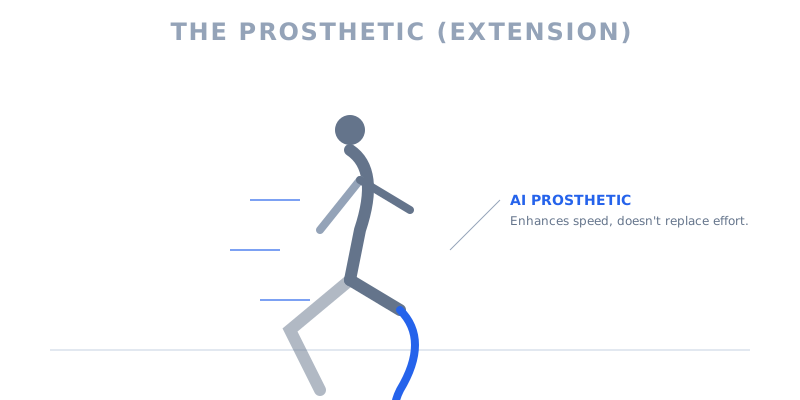
By the grace of God, we have been given LLMs not just as "chatbots," but as Cognitive Prosthetics. Offloading isn't about being lazy; it's about being efficient with the limited mental energy we are given. When we delegate the "drudge work" to the machine, we are clearing the workspace for the soul to focus on what actually matters: service, connection, and creation.
The Metadata Sludge vs. The Logical Signal
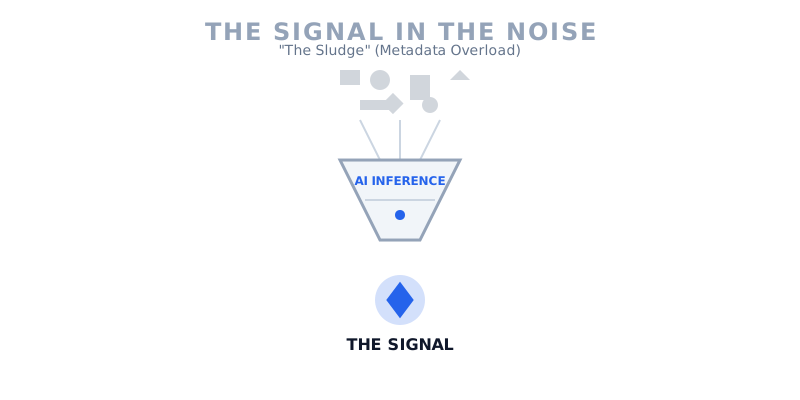
Modern life is 80% "Sludge"—the bureaucratic metadata that acts as a tax on our attention. Scheduling, parsing legal jargon in terms of service, summarizing long-winded corporate reports, and filtering through infinite email threads are all tasks that drain our Executive Functions. AI is best at offloading these specific high-volume, low-impact tasks, with a primary focus on summarizing long documents or searching for specific facts.
When you use an LLM to "Give me the logical core of this 50-page PDF," you are initiating a high-density Inference Session. The model uses its vast pre-trained Neuro Weights to identify the Semantic Signal within the noise. This allows the Sovereign Scout to grasp the architecture of an idea without needing to manually crawl through every redundant sentence.
Think of it like the "Search" function on a vintage PC, but for the meaning behind the words. If you are a parent trying to navigate complex medical options for your child, or a self-taught engineer like myself looking for a specific break in a codebase, offloading the "Search and Synthesis" to AI saves hours of manual labor. This is the essence of AI Mastery —knowing how to point the machine's power at the Sludge so you can walk through the Signal.
Tactical Insight: The Offloading Loop
Mastering the Loop requires a shift in how you view your interaction with Artificial Intelligence. You must move from "Asking Questions" to "Delegating Logic." Use these three pillars to preserve your mental bandwidth:
- 1. Executive Function Support: Many of us with different brains struggle with the "In-Between" steps. AI excels at helping with task management, scheduling, and breaking down complex goals into manageable, logical micro-steps. It acts as a Digital Chief of Staff that never forgets the sequence.
- 2. Reducing Decision Fatigue: Human willpower is a depletable resource. Decision Fatigue is reduced by using AI to narrow down options or provide pros/cons for complex scenarios. Ask the AI to "Play devil's advocate for this decision" to reveal blind spots without the emotional cost of overthinking.
- 3. Information Synthesis: Use Context Engineering to compress massive amounts of information. Before you read a book, ask the AI for the Skeleton of Arguments. If the skeleton doesn't serve your mission, don't waste the time reading the flesh.
Digital Second Brains & External Memory
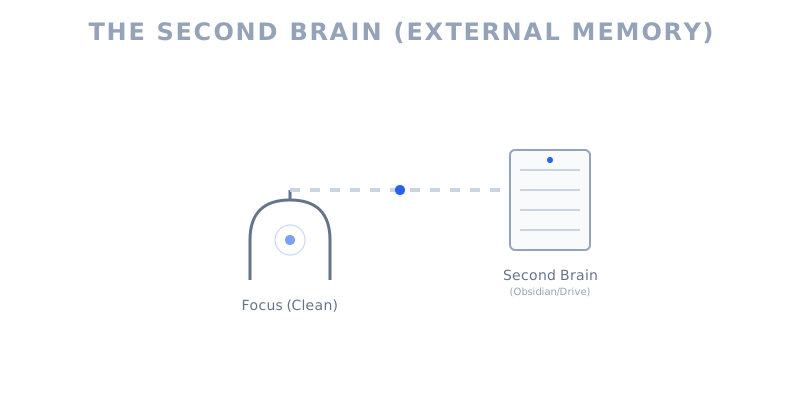
The concept of a Second Brain is the cornerstone of 2026 cognitive survival. A Second Brain system usually involves a digital note-taking and knowledge management system—such as Obsidian, Notion, or a locally hosted Zettelkasten—that acts as your external hard drive for insights. For a self-taught technical mind, this system is where the "Pattern Recognition" is documented and refined.
When you integrate AI into your Second Brain, you aren't just storing text; you are creating a Dynamic Knowledge Graph. AI can help you find connections between disparate notes—perhaps linking a concept from a 1992 motherboard schematic to a modern 2026 Vibe Coding logic. By offloading the "Memory" to your external system, you keep your Biological RAM available for active, real-time Problem Solving.
I think of my friend TJ Beach often when I think about legacy and memory. We have a responsibility to preserve what we learn, to be stewards of the patterns we've seen. Using AI to manage our Personal Knowledge Bases ensures that the wisdom we've fought for isn't lost to the entropic noise of a busy life.
The Pursuit of Scientific Literacy: Cracking the Expert Wall
True sovereignty requires Scientific Literacy—the ability to understand the laws of the physical and digital world. However, the world of modern academia and "Expertise" has become a gated community, protected by a wall of impenetrable jargon. AI can increase Scientific Literacy by translating complex jargon into simple, actionable explanations. It acts as a Universal Translator for concepts that were previously locked behind expensive degrees or dense economic whitepapers.
For example, a family in Rural Wisconsin, should be able to parse a complex environmental study about their local water table as easily as they read the morning news. By asking an LLM to "Explain this study through the lens of First Principles logic while identifying any statistical anomalies," we empower individuals to bypass the gatekeepers and see the Raw Truth of the data.
This is service. This is helping our neighbors see through the Truth Decay of our era. By offloading the "Decoding" of the jargon, we can spend our time on the Tactical Implementation of the facts.
The Sovereign Scout: Critical Thinking vs. The Laziness Trap
We must address the elephant in the room: the risk of Cognitive Atrophy. If you use AI to think *for* you, you become a slave to its biases. You should not offload Critical Thinking; instead, AI should assist the process, but never replace the human's final judgment. This is the difference between a Cognitive Prosthetic and a Cognitive Crutch. A prosthetic helps you run where you otherwise couldn't; a crutch makes you weak because you refuse to stand.
Maintaining the integrity of your Internal World Model—your deeply held perception of reality—is your most critical duty as a free person. If you allow the AI to curate your values or determine your moral logic, you have sacrificed your Sovereignty.
The Master uses the machine to generate Counter-Arguments and verify Factual Grounding, but the Master always makes the final call. We use System Prompts to ensure our AI acts as a Research Assistant rather than a Rural Minnesotal Guide. We are the stewards of the "Out" of our lives.
Intergenerational Legacy: Preservation via Offloading
There is a deeper, more spiritual aspect to offloading. By delegating the trivia of the present, we find the time to preserve the narratives of the past. In my work at Thrifty Flipper and Crypto Wiz Hub, I see how information can be lost if it isn't synthesized. AI allows us to take the scattered memories, old letters, and historical anecdotes of our families and offload the "Organization" of those stories into a coherent Family Archive.
This is how we ensure that our children don't start from zero. We offload the synthesis of our own failures and successes so they can inherit a Structured Map of Wisdom. This is Generational Wealth in its truest sense—the wealth of knowledge and pattern recognition, preserved by the grace of God and the help of the machine. Projects like Thrifty Flipper and Crypto Wiz Hub are my attempts to build these containers of value for the next generation.
Conclusion: The Augmentation Era
Ultimately, Cognitive Offloading with AI leads to greater leverage and the ability to solve more complex problems. We are moving from a world where we are limited by our biological memory to a world where we are limited only by our Architectural Intent. We are stewards of a New Intelligence, and we have a responsibility to use it for the good of our families and neighbors.
Don't waste your bandwidth on the Sludge. Clear the workspace. Master the logic. And use every saved minute to serve those who cannot yet see the patterns.
This is the "In and Out" of the modern world. Let's make it count.