The Master Teacher in the Machine
The standard way people use AI is the "Direct Request": They ask a question, and the machine spits out an answer. In an educational context, this is a missed opportunity. Real learning happens when the student is forced to struggle with the pattern. Real learning happens in the "gap" between the question and the solution. This is where the Socratic Tutor Persona becomes a definitive high-authority tool. In 2026, we have moved beyond simple "chat." We are now in the era of Cognitive Orchestration, where the AI doesn't just process data—it processes the student's Mental Models.
The Socratic Method is based on asking guiding questions to stimulate critical thinking. Instead of being a source of static information, the AI acts as a pedagogical guide, leading the student toward the "Aha!" moment through iterative realization. This transition from passive consumption to active Inquiry-Based Learning is the hallmark of the AI Mastery Path. By shifting the burden of logic back to the human, we ensure that the In of information becomes an Out of genuine wisdom.
The tutor is a guide, not a source. This is a fundamental shift in our relationship with technology. Real learning happens by asking questions and solving problems, not by memorizing answers. When we use a System Prompt to define a Teacher Persona, we aren't just changing the "vibe" of the AI; we are dictating its educational philosophy and operational tone. This philosophical anchoring is what prevents the AI from falling into the "Helpfulness Trap"—the tendency of LLMs to provide the quickest path to a result, even if it circumvents the learning process.
Why Discovery Trumps Direct Answers

Why would a student use a Socratic AI instead of a standard chatbot? The goal is todeeply understand the logic behind a concept. If an AI tells you that 2+2=4, you have a fact. If an AI asks you to visualize two apples and then two more, you have an internal world model of addition. This is the difference between Surface Learning and Deep Pattern Recognition. The Socratic tutor acts as a mirror, reflecting the student's own logic back at them until the flaws in their mental architecture become self-evident.
This method is particularly effective for subjects involving logic, ethics, literature, or problem-solving. Whether you are analyzing the ethical weight of a client privilege dilemma or debugging a vibe coding error in React, the Socratic approach forces you to examine the First Principles of your own decision-making process. It moves the student from "What is the answer?" to "Why is this the answer?"—a tactical shift that is essential for sovereignty in the age of AGI.
The tutor doesn't just supply information; it provides Conceptual Scaffolding. It meets the student where they are, offering a bridge to the next level of complexity. This isn't "cheating"; it is Cognitive Acceleration.
Architecting the Persona: The System Layer
A Teacher Persona in AI is defined by a set of guidelines in the prompt that dictate its tone and educational philosophy. To build a high-performance mentor, you must master Prompt Structuring. You aren't just asking the model to "be a teacher"; you are engineering its Inference Out to prioritize Diagnostic Hesitation. This is a deliberate slowing down of the response cycle to ensure the AI doesn't over-solve the student's problem.
For example, a masterful Socratic prompt uses Delimiters to separate the Core Rules from the Student Context. You might instruct the AI: "If the user provides an incorrect answer, highlight the logical inconsistency without revealing the correct path. Ask a follow-up question that addresses the root cause of the misunderstanding." This requires the model to use its Neuro Weights to analyze the *intent* behind the mistake, rather than just the error itself.
The "Truthful Tutor" Constraint
One of the most powerful aspects of modern Large Language Models is their ability to handle nuance. Can an AI admit when it doesn't know something?Yes, if prompted to be an honest, high-integrity tutor. In theSocratic Framework, intellectual honesty is a feature, not a bug. It teaches the student that Inquiry is more important than perceived Authority. By admitting Model Limitations, the tutor builds rapport and trust, modeling the very Critical Thinkingit aims to instill in the learner.
Learning Frameworks: Scaffolding and Bloom's
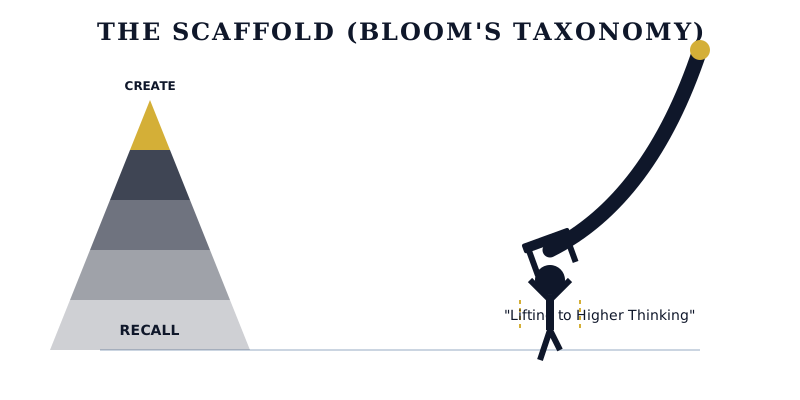
In professional pedagogy, we use the term Scaffolding. This refers toproviding temporary support that is removed as the student gains mastery. AI is the ultimate scaffolding tool. It can sense your level of Token Retention and adjust the difficulty of its questions in real-time. This isAdaptive Education powered by Compute Sovereignty. The AI provides the "scaffold" for a complex thought, then slowly withdraws as the student's own Context Density increases.
By guiding students through these layers, we move them up Bloom's Taxonomy. This framework for categorizing educational goals ranges from simple remembering to complex creating. A Socratic AI doesn't want you to just Remember that Inference is the "thinking" phase; it wants you to Analyze the Neuro Weights of the model to Evaluate its performance. This progression ensures that the knowledge is internalized rather than just interfaced.
We are building higher-order thinking skills. We are moving from the Consumer Mindset to the Architect Mindset. This is why the structure of the interaction is more important than the content of the interaction.
The Strategic Implementation of Irony
Socrates was known for his use of irony—pretending ignorance to draw out the misconceptions of his interlocutors. In the world of AI, we can program this Strategic Ignorance. By instructing a model to act as if it is unfamiliar with the final conclusion of a logic chain, we force the student to become the Source of Truth. This is a powerful Mastery Technique that reverses the traditional power dynamic of education.
Think of it as Inference Engineering for the human brain. We are optimizing the Biological Neural Network by using the Silicon Neural Network as a stress-test. If a student can explain a concept to an "ignorant" AI, they have achieved true Domain Mastery. This is the "In" of instruction becoming the "Out" of expertise. It requires the student to reach the Create layer of Bloom's Taxonomy, where they are generating the logic themselves.
This technique also helps identify Hallucinations. If the model is pretending ignorance and the student provides a false premise, the model must break character to correct the logical drift. This creates a high-stakes verification loop that keeps the student sharply focused on the data.
The Role of Empathy and Integrity
An Empathetic tutor is one that responds to the student's frustration or enthusiasm with appropriate encouragement. Because an LLM has infinite patience, it can provide a safe space for Special Needs Support, allowing a student to fail multiple times without social judgment. This Non-Judgmental Feedback Loop is revolutionary for learners who have felt "pushed out" by the fast-paced, standardized classroom environment.
This creates a Positive Feedback Loop where discovery retentionis maximized. The emotional safety of the interaction allows the student to engage in Vulnerability-Based Learning. They aren't afraid to say "I don't know," because they know the AI won't sigh or move onto the next student.
The ultimate goal of a Socratic AI is not to be a permanent crutch, but to turn the student into an independent, critical thinker. We use the machine to build the mind, then we move beyond the machine. As a follower of Christ, I see this as a form of Stewardship—using the gifts of technology to empower the unique gifts within every human soul. It is an act of Service to provide every child with the equivalent of a tutor from the Library of Alexandria.
The Logic of the Scavenger
When I was scavenging parts from electronic recycling bins in Rural Wisconsin, I didn't have a Socratic tutor. I had a Multimeter and a Soldering Iron. I had to ask the *circuit* the questions. "Why aren't you passing current?" "Is this capacitor blown?" The circuit didn't give me an answer; it gave me a signal. I had to interpret that signal to find the truth. That feedback loop was my education.
This experience—drilling down into the physical reality of a board until the logic reveals itself—is exactly what qualifies me to lead this exploration into AI. I don't just see a "chatbot"; I see a series of Logic Gates andInference Cycles that can be debugged and optimized. Whether I'm building a React Component or a Prompt Pipeline, I am always looking for the "trace" that leads to understanding. This technical grounding ensures that the "Ins and Outs" of this site are rooted in engineering reality, not just theoretical abstraction.
The Teacher Persona is simply a way to automate that process of discovery for everyone. It takes the Hacker Mindset of the Rural Wisconsin dump and scales it to the entire world. It democratizes the Sovereign Path of self-directed education, making the master mentor accessible to anyone with a Token Budget.
Whether you're fixing a motherboard or a moral argument, the process is the same. Trace the lines. Test the tension. Find the fault. This is the Architecture of Attention.
Stewardship and the Rural Minnesotal Compass
We must ensure that our tutors are grounded in Rural Minnesotal Discernment. An AI tutor without an ethical framework is just a high-speed library card. By building integrity into our system prompts, we ensure that the AI doesn't just teach the "How," but also the "Why." We are stewards of the next generation's Epistemology—their entire way of knowing.
This is where Truth Decay is fought. In a world of deepfakes and synthetic noise, the Socratic tutor acts as an Anchor of Inquiry. It forces the student to verify their sources and justify their logic. It builds a Cognitive Shield against manipulation.
Summary: The Sovereignty of the Mind
As we navigate the AI Era, we must choose whether we want to be Answer-Checkers or Inquirers. By the grace of God, we have been given tools that can mimic the best teachers in history. Whether you are homeschooling a child or teaching yourself Quantum Computing, the Socratic Method ensures that the information isn't just "In," but that it manifests as a Structured Map of Wisdom.
The Teacher Persona is the ultimate High-Authority Tool. It moves us from the Industrial Model of "One-to-Many" instruction to the Sovereign Model of "One-to-One" mentorship. Master the System Prompt. Build the Scaffolding. And always remember: the best teacher isn't the one with all the answers, but the one with the best questions.
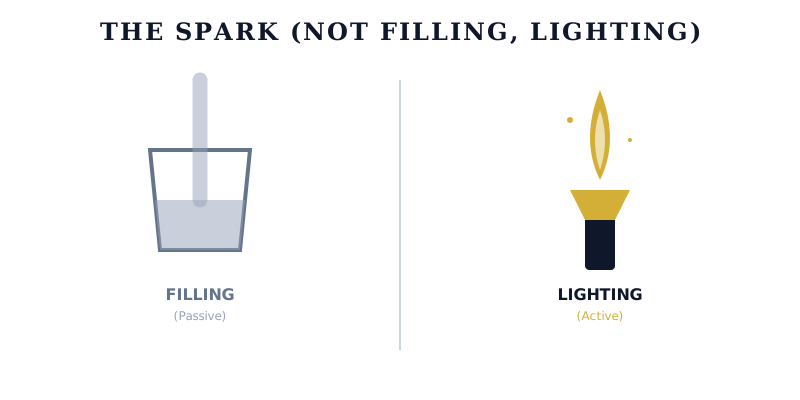
The goal is not to fill a bucket, but to light a fire. The Silicon Socrates is here to hand you the match. What you build with that fire is your service to the world.
For a deeper look at how this logic applies to different brain types, visit our module on Special Needs Support.