The Bridge Over the Gap
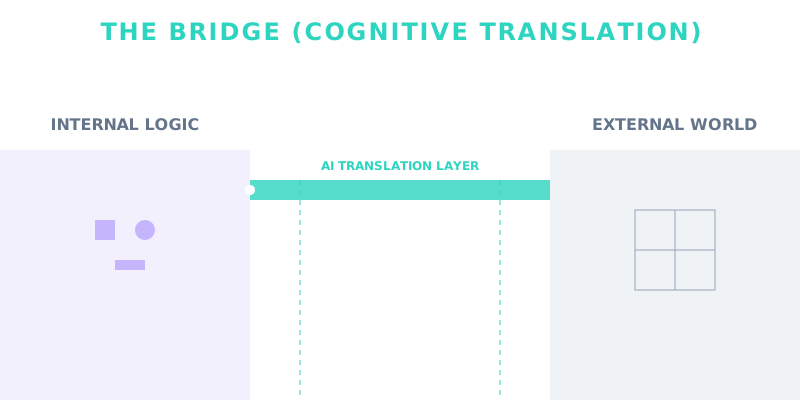
Knowledge is a gift that should be accessible to everyone, regardless of the architecture of their brain. As someone who lives in the world of high-functioning autism, I am acutely aware of the "gaps" that can exist between internal logic and external expression. For many, these gaps are widened by conditions like dyslexia, ADHD, or sensory processing disorders. AI is the most significant bridge over these gaps ever created.
When I look at a complex technical document, my brain sees patterns, but it can also become overwhelmed by the "sludge" of social context and unorganized information. By using an LLM to Simplify Concepts, I can strip away the noise and focus on the "Ins and Outs" of the logic. For a student with dyslexia, that same technology can transform a wall of intimidating text into a structured, bulleted roadmap that their brain can actually process. This is the essence of Cognitive Augmentation: using external silicon to assist biological carbon.
The beauty of Generative AI is that it doesn't care how many times you ask it to rephrase a sentence. It provides highly tailored, patient, and multi-modal support for unique learning needs. This is not just a tool; it is a Cognitive Prosthetic. It fills the void left by standard systems that were built for the "average user"—a user who does not truly exist. In the AI Era, we have the ability to Personalize Education at the scale of the individual, ensuring that no mind is left behind due to a lack of technical or social translation.
Personalized Scaffolding and Infinite Patience
One of the greatest barriers in traditional education is the "Judgment of the Clock." A student who needs ten explanations for a single concept often feels the social pressure to nod along, even while remaining in the dark. AI removes this pressure completely. AI is defined by its Infinite Patience. A student with Special Needs can repeat a question 100 times without judgment. This creates a safe, low-stakes environment where Discovery Retention can actually take place.
Beyond patience, AI provides Personalized Scaffolding. This refers to the temporary support structures that a tutor builds around a student, which are gradually removed as mastery is achieved. In the context of a Personalized Learning Plan (IEP), AI can generate and track progress more effectively than manual systems. It senses when a student is struggling with a specific Logic Gate and offers a new analogy, a visual description, or a simplified summary to bridge the misunderstanding.
For the student with an IEP, the AI acts as a 24/7 assistant that understands their specific Cognitive Profile. It doesn't just teach math; it teaches math in the way that the student's brain is wired to receive it. This is Adaptive Learning in its purest form, where the Information Flow is constantly redirected based on real-time feedback.
This is particularly vital for students who require Sensory-Friendly Learning. The AI can adjust its Output Tone and complexity to match the student's current Context Density. It meets the student where they are, rather than demanding they move to where the curriculum is. AI handles repetition and adapts to individual IEPs by maintaining a Long-Term Context of the student's struggles and successes.
Executive Function: The ADHD Support Suite
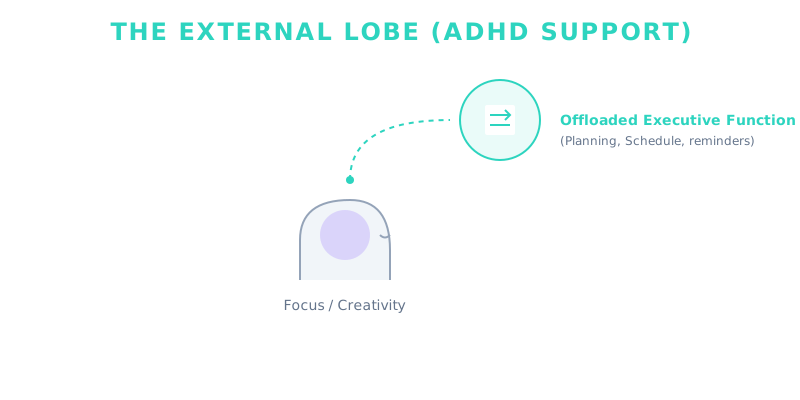
For those with ADHD, the challenge is often not the lack of intelligence, but the difficulty in Executive Function—the ability to plan, prioritize, and execute multi-step tasks. AI is the world's most effective tool for breaking large tasks into micro-steps and providing reminders and structure. It acts as an external frontal lobe, helping the brain stay focused on the "Now" while managing the "Next."
Techniques like Prompt Structuring can be used to turn a vague assignment into a Tactical Checklist. Instead of facing a "write an essay" prompt, the student uses AI to identify the First Principles of their argument and then builds the structure piece by piece. This reduces Task Paralysis and Decision Fatigue, two of the primary blockers for neurodivergent individuals.
The AI can also assist with Time Blindness, a common ADHD trait, by estimating how long each micro-step will take and providing Cognitive Anchors to keep the student on track. By offloading the Cognitive Load of organization to the machine, the student is free to use their unique Pattern Recognition and creative energy for the actual work. This is Cognitive Offloading as a form of empowerment, allowing the ADHD brain to thrive in environments that were previously hostile to its nature.
This is the Sovereign Path to productivity. We don't try to force the ADHD brain to be "normal"; we provide the tools that allow it to be Specialized. By using the machine to manage the Administrative Sludge of life, we unlock the Hyper-Focus that is the hallmark of the neurodivergent gift.
Autism and the Logic-First Interface
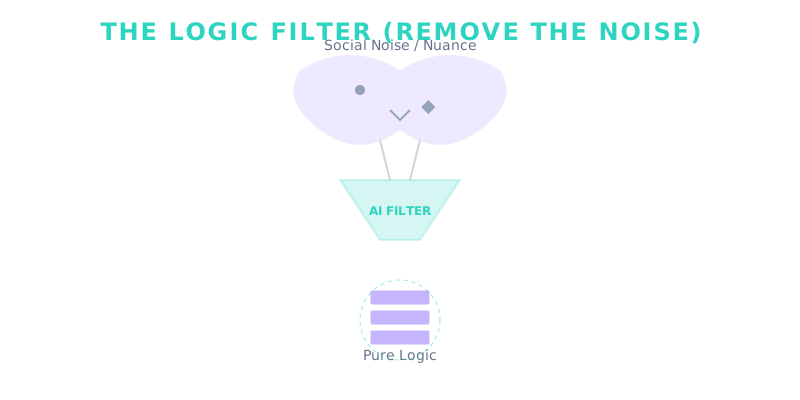
In my own experience with High-Functioning Autism, social nuances can often clouds the transfer of information. AI provides a Logic-First Interface. For individuals on the spectrum, AI can act as a low-stakes social simulator and a clear, literal communicator. It doesn't use sarcasm (unless you ask it to), and it never has any "unspoken expectations."
The Socratic Method combined with an Explicit Communication Style allows an autistic student to analyze the world through Pure Logic. They can use AI to practice Social Scripting or to understand the Latent Space of human emotion by asking for literal breakdowns of non-literal language. This reduces the Social Friction of learning, allowing the student to achieve Domain Mastery without the burnout associated with constant Masking.
Furthermore, for those with impaired speech, Alternative and Augmentative Communication (AAC) tools are being revolutionized by AI. These tools help people with speech impairments communicate through AI-voice based synthesis that can predict intent and generate high-fidelity speech in real-time. This is Inference Out becoming the literal voice of the soul. It bridges the gap between the thought and the spoken word, ensuring that Non-Verbal Brilliance is never again mistaken for a lack of intelligence.
By acting as a Social Interpreter, AI allows the autistic individual to navigate the Neurotypical World on their own terms. It translates the vague into the specific, and the emotional into the logical. This is not about changing the person; it is about Expanding the Interface through which they interact with reality.
Literacy, Vision, and Multimodal Support
For the dyslexic learner, Text-to-Speech is more than a convenience; it is a necessity for blind users or those with dyslexia to access written information. AI simplifies this by providing Auditory Learning pathways for every piece of data. It can also perform Plain Language Summarization, simplifying complex language for someone with cognitive disabilities while retaining the Technical Integrity of the topic.
In the realm of visual impairment, Multimodal AI acts as digital eyes. Visual Description involves the AI describing an image or surroundings for someone with low vision in vivid detail. By analyzing Context Windows of image data, the AI can explain the Visual Patterns of a room or a textbook diagram, ensuring that no information is lost to the darkness.
These tools facilitate Vulnerability-Based Learning. A student can admit they "don't see" or "can't read" a certain block of data, and the AI will immediately provide a Tactical Translation. This ensures Equity of Access in a world that is too often built for a single type of perception. The integration of Vision Models and Speech Synthesis creates a Universal Interface that adapts to the user's primary Sensory Input.
Whether it is through Braille Translation or High-Contrast Summaries, AI ensures that the Barriers to Entry for knowledge are systematically dismantled. We are moving toward a Post-Disability Information Age, where the machine compensates for the limitations of the body to liberate the potential of the mind.
The Architecture of Inclusion
As a follower of Jesus Christ, I am reminded that every person is fearfully and wonderfully made. "Special needs" is often just another way of saying "uncommon gifts." My autism is a gift—it is what gives me the Pattern Recognition that powers this entire site. AI helps society finally acknowledge these gifts by providing the tools to translate different ways of thinking into shared success.
When we build for Neurodivergence, we build for everyone. The Clear Communication and Structured Maps of Wisdom required for a student with special needs actually benefit the Universal Human Mind. By providing the equivalent of a tutor from the Library of Alexandria to every child, we are practicing true Stewardship of the human spirit.
This is how we serve families. We provide them with a Cognitive Translator. For the parent of a child who feels "broken" by the standard school system, AI is the proof that their child's brain isn't broken—it's just a different Operating System. By using these High-Authority Techniques, we can build custom educational pathways that celebrate differences rather than punishing them.
The Goal of AI in Accessibility is not to "fix" people, but to empower independence and reduce barriers to information and community. We use the machine to highlight the human, not to replace it. This is the Sovereign Path: where technology serves the soul, and Epistemology is reclaimed by the individual.
Summary: The Sovereignty of the Mind
The AI Era is the era of Cognitive Diversity. We no longer need to force every brain into the same Industrial Model of learning. Through Adaptive Education and Technical Sovereignty, we can ensure that the "In" of instruction matches the "Out" of a student's potential. Whether it is through Text-to-Speech, Social Simulation, or Executive Function Support, the end result is the same: the Sovereignty of the Mind.
For a deeper look at how history can be brought to life through these same techniques, visit our module on Interactive History.