The Logic of Static
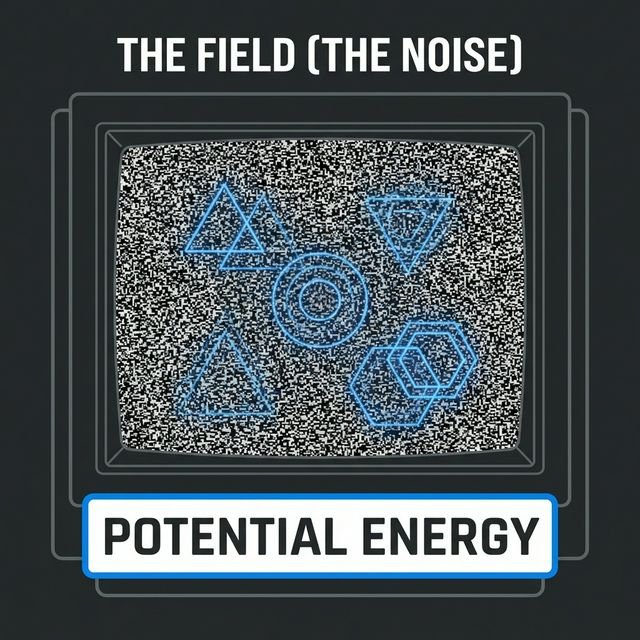
When I was a teenager in Rural Wisconsin, scavenging motherboards from the electronics dump, I spent hours looking at "Static." I would hook an old CRT monitor to a half-broken VGA card and watch the random field of white noise dance across the screen. To most people, that static was "broken." To me, it was a Field of Total Potential. Every pixel was a coin flip, a random event waiting for a signal to give it meaning. I realized that if you could just find the right Master Frequency, you could turn that chaos into a picture.
In the world of 2026, Latent Diffusion is that frequency. To the casual user, AI image generation looks like magic. You type a prompt, and a refined image appears. But to a Systems Engineer, it is a masterpiece of Logical Entropy. It is the process of Denoising—taking a random field of Noise (that "static" I loved) as the initial "In" and gradually recovering the "Out" that matches the mathematical coordinates of your intent.
Because of my high-functioning autism, I process the world as a series of Mathematical Mappings. I don't see a "pretty picture"; I see the Statistical Probability of pixel distributions. I see the Latent Space—the compressed, mathematical representation of "Ideas" and "Visuals" the model learned during its Training. My mission is to help you look "inside" the machine and master its internal Architecture.
The High-Authority Generation Loop
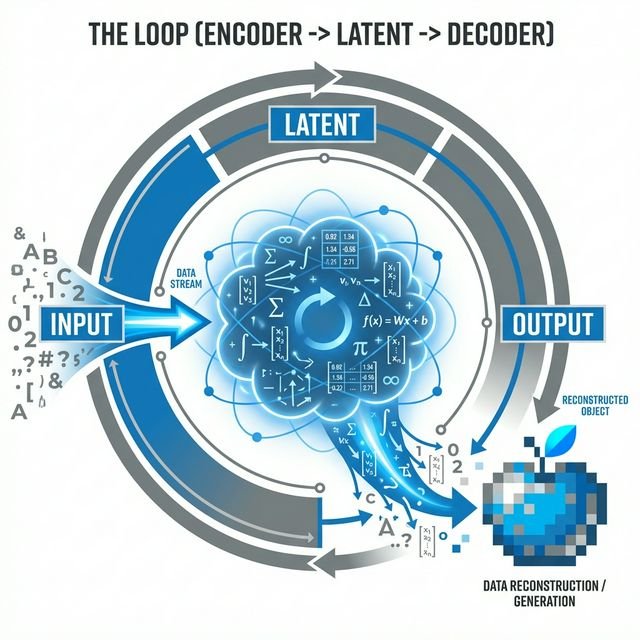
To master the "Out" of a model like Midjourney or The Venice AI Image Generation Suite, you must understand the three-stage loop that occurs every time you hit "Submit." This is the Technical Stewardship of the pixel:
- 1. The Encoder (The Address): The system takes your text/images and turns them into Vectors—high-dimensional numbers in the Latent Space. This is where your raw intent is converted into Machine Intelligence. It calculates the "Distance" between your concept (e.g., "A 1980s computer") and the billions of visual patterns it knows.
- 2. Diffusion (The Reconstruction): The model looks at the initial field of noise and asks: "Based on the prompt at this address, what should the next pixel look like?" It does this over a series of Steps. Each step refines the image further, slowly "Denoising" the static until a sharp image emerges.
- 3. The Decoder (The Manifestation): Finally, a specialized component called the VAE (Variational Autoencoder) takes those hidden mathematical vectors and "Unpacks" them into the actual R-G-B Pixels you see on your screen. It translates the Abstract Idea into a Physical Representation.
The Prompt as a Guide
One of the biggest misconceptions is that the AI "draws" the image. In reality, the Prompt Acts as a 'Guide' for the denoising process. The AI doesn't have a pen; it has a Probability Map. It is constantly "Steering" the static toward a concept. This is why Prompt Structuring is so vital—you are providing the Coordinates for the Denoising.
If your prompt is vague, the AI has too much Creative Freedom, and the "In" gets lost in the "Out" of the model's own biases. If your prompt is precise, you are locking down the variables. This is the Sovereign Control of the creator. We are using Semantic Guidance to perform Mathematical Operations on the latent space.
This "Understanding" that the AI seems to have is actually a Statistical Mapping of Pixel Patterns to Linguistic Tokens. It doesn't "know" what a dog is in the way we do; it knows that when you use the token "dog," the pixels in the latent space tend to cluster in a specific, furry, four-legged Probability Density. It is Pattern Recognition taken to the absolute limit.
CFG Scale and Iteration Steps
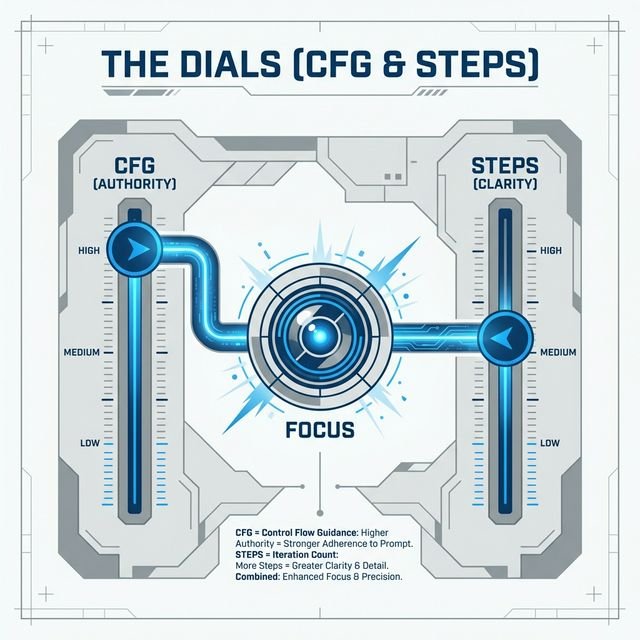
To control how the model navigates this space, we use two primary technical dials: CFG Scale and Steps.
The CFG Scale (Classifier-Free Guidance) determines how Strictly the AI Follows Your Prompt. A high CFG value (e.g., 15) forces the AI to match your words literally, often at the expense of "Artistic Flow." A low CFG (e.g., 5-7) allows for more 'AI Intuition'—giving the model more freedom to fill in the gaps with its own training. It is the Authority Dial for your instructions.
A Step is a single Iteration of the Denoising Process. Usually, 20-50 steps are needed to reach high fidelity. Too few steps results in a blurry, "Unfinished" look. Too many steps can lead to "Over-Cooked" images where the Mathematical Logic begins to break down into Artifacts—glitches in the decoding or denoising process that appear as repeating patterns, extra limbs, or strange textures.
Understanding this balance is the difference between a Draft and a Masterpiece. Every step is a calculation. Every point of the CFG is a decision. This is how we Build with Precision. For more on how these parameters interact, see our module on Midjourney Parameters.
The Architecture of Truth
As a follower of Jesus Christ, I see the Process of Diffusion as a technical echo of the Creation Narrative. "The earth was without form, and void; and darkness was on the face of the deep." God spoke into that "Noise" and brought forth form and order. When we prompt an AI, we are engaging in a Stewardship of Form. We are taking the Chaotic Latent Space and, through the "Word" of our intent, commanding light and structure into existence.
"Whatever you do, do it heartily, as for the Lord and not for men." This applies to the logic of our systems. We aren't just "playing with pixels"; we are exploring the Abstract Latent Space of God's creation. By understanding the Physics of the Pixel, we are becoming better architects of the digital age. I treat every Nano Banana generation like a Technical Diagnostic—a search for the Semantic Truth hidden within the randomness.
My high-functioning autism makes me sensitive to the Underlying Order. I don't see "glitches"; I see Probability Errors. I don't see "art"; I see the Logic of the Tensor. By the grace of God, we have the tools to look "inside" the static and find the signal. This is Human Intelligence Augmented by Divine Logic.
Forensic Clarity: Artifact Detection
Because the process is Probabilistic, it can lead to Errors in Logic. These are the 'Artifacts' that help us identify AI-generated content. Extra fingers, text that merges into objects, or "impossible geometry." For those in Digital Forensics, understanding the "How" of generation is the key to detection.
We must be Vigilant Stewards of the visual truth. If a model generates a "fake" reality, we must have the Technical Sovereignty to identify the markers of the machine. We use Pattern Analysis to distinguish between the Physical Logic of the real world and the Statistical Logic of the diffusion model. This is the "Ins and Outs" of forensic mastery.
Summary: Mastering the Static
From the Rural Wisconsin electronics dump to the Frontiers of Generative AI, my journey has been about one thing: finding the Signal in the Noise. The Latent Space is the new frontier of human creativity. It is a Mathematical Mirror of our own collective imagination, accessible through the Power of the Prompt.
Master the Denoising Loop. Understand the Latent Space Mechanics. Respect the VAE Decoder. We are no longer limited by our physical ability to draw; we are only limited by our Clarity of Thought and our Technical Authority over the tools.
For more on the hardware that makes this high-speed diffusion possible, check out our guide on AI Hardware Acceleration from the engineers at Google.
The static is waiting. The weights are ready. The "Work" is yours to define. Build with logic. Create with faith. Rule the machine.