The Silicon Witness
When I was thirteen, scavenging for motherboards at the Rural Wisconsin dump, I realized that electronic components don't have human motives. They don't lie, they don't forget, and they don't have biases. A damaged capacitor is just a physical fact. In the world of 2026 investigations, Digital Forensics is the recovery and investigation of material found on digital devices. It is the process of letting the silicon "speak its truth." Whether it's a smartphone, a cloud server, or an IoT-connected doorbell, every device is a witness.

The Challenge: Terabytes of Noise
The challenge isn't that the data is missing; it's that there is too much of it. A single investigation can generate terabytes of Metadata—information about the data, such as when a file was created or where a photo was taken. Finding a specific lead in a multi-petabyte server log is the definition of "a needle in a haystack." Traditionally, forensic analysts had to rely on manual Log Parsing, searching for specific timestamps or IP addresses. But in the era of Generative AI, we can automate the "In" of technical data to find the "Out" of forensic certainty.
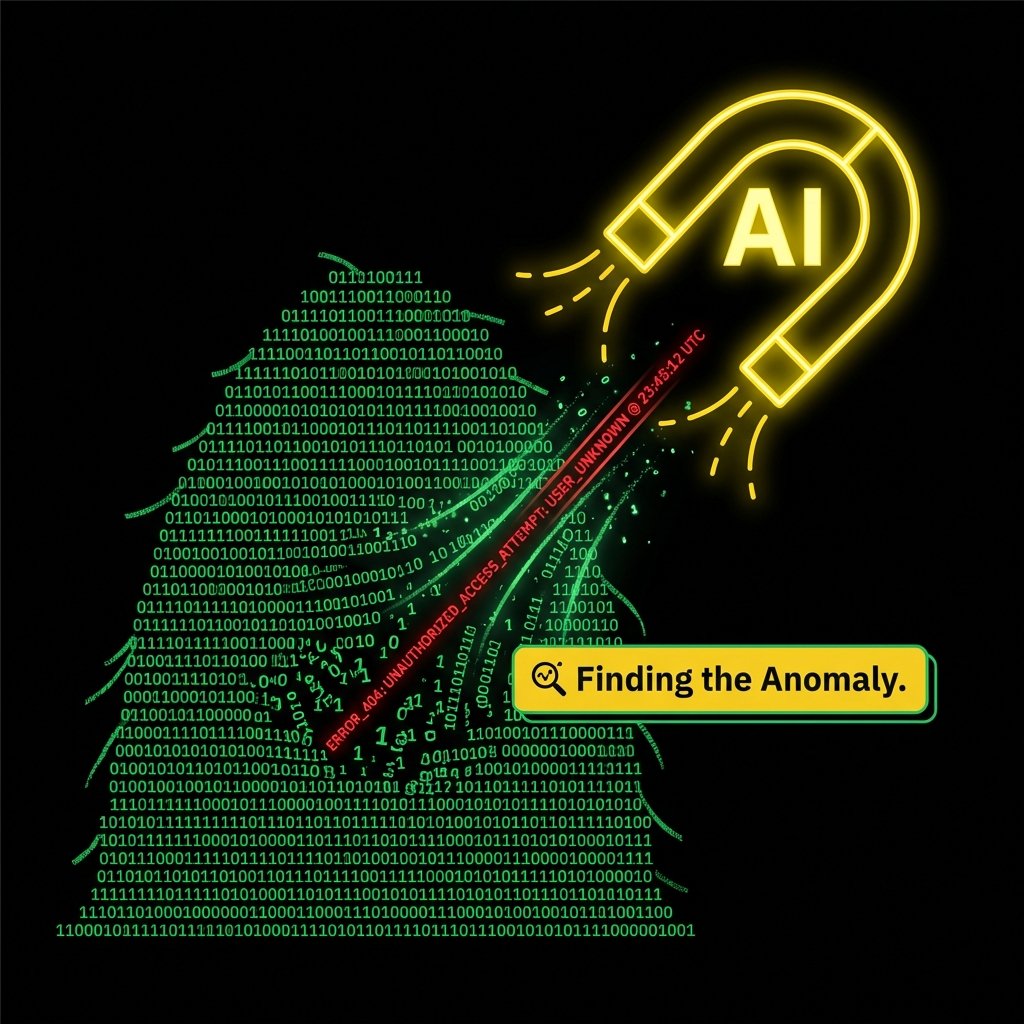
Because of my high-functioning autism, I have always seen Logic Flows where others see noise. I see the "Ghost in the Code"—the subtle shifts in system interrupts that signal a breach. By using AI, we are amplifying this Pattern Detection capability, allowing every investigator to parse millions of records in seconds. We are moving from Manual Triage to Intelligent Forensics.
Tactical Insight: The Forensic Mindset
The primary "Forensics" mindset is one of Absolute Preservation and Meticulous Documentation. In digital forensics, the first rule is to never touch the original evidence. We use a Write Blocker—a specialized hardware interface—to prevent any changes to a device while its data is being imaged.
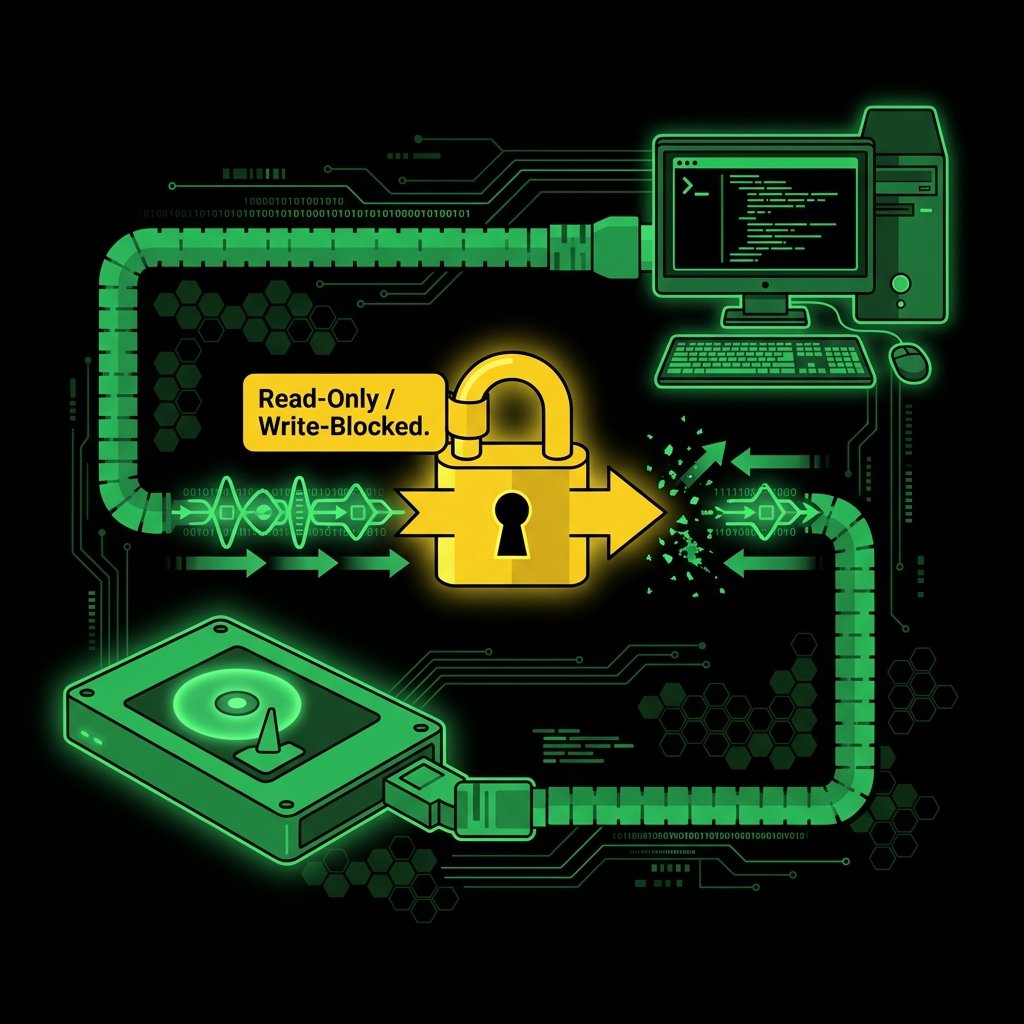
Once the image is created, the Chain of Custody begins. This is the chronological documentation of who handled the device and when. In the 2026 landscape, we use Automated Logging and cryptographic hashing to ensure that the evidence remains untampered from the crime scene to the courtroom. We are building Systems of Integrity.
AI and the Art of Log Parsing
Syslogs, network traffic, and application event logs are the "Digital Footprints" of a suspect. AI helps with Log Parsing by automatically identifying suspicious patterns in thousands of system records. Instead of looking for a specific string of text, the AI looks for Behavioral Anomalies.
Is a user account suddenly executing commands it has never used before? Is there a burst of Metadata Inconsistency between a file's creation time and its last-access time? Modern Neural Networks can identify these fractures in the baseline of "normal" system behavior. For those looking to see how this is done manually, tools like Wireshark are the gold standard for network analysis.
By using Local AI Models, we can perform this analysis without ever exposing the sensitive logs to a cloud provider. We are keeping the Forensic Data Sovereign. We are using the machine to audit the machine.
Beyond the Visible: Steganography and Deepfakes
Evidence isn't always sitting on the surface. Suspects often use Steganography—the practice of hiding data within another file, like an image or a video. To the human eye, it's just a JPEG of a sunset. To an AI trained on Statistical Anomaly Detection, it is a carrier for hidden text or decryption keys. The AI can look for "synthetic noise" or anomalous pixels that indicate the presence of hidden data.
Similarly, the rise of Deepfakes has created a new frontier for forensic analysts. We can use Deepfake Detection AI to identify synthetic patterns in video and audio that are invisible to the human eye. By analyzing the "Digital Pulse" of a video—the subtle variations in light and movement—the AI can determine if a recording is a Manifestation of Reality or a mathematical hallucination.
This is the "AI to catch AI" loop. As the models for generation improve, the models for detection must evolve even faster. We are in a high-stakes race to preserve the Integrity of the Visual Record. For open-source forensic toolsets, Autopsy is an essential resource for practitioners.
The Encryption Barrier
One of the greatest challenges in digital forensics is Encrypted Data. When a suspect's phone or hard drive is locked behind 256-bit encryption, traditional methods fail. However, AI can assist by analyzing Traffic Patterns and identifying potential keys or vulnerabilities in the implementation of the entropy.
While AI can't "magically" break encryption, it can assist in high-speed Brute-Force Analysis and Social Engineering Mapping to identify potential passwords based on the suspect's Digital Persona. We can use the Probability Engine to rank the likelihood of specific passphrases, significantly reducing the "Search Space" for investigators.
This level of analysis is often performed on specialized operating systems like Kali Linux. We are combining Offensive Security Tools with Defensive Forensic Reasoning. It is a Service of Stewardship to ensure that no "hidden corner" of a device remains a sanctuary for injustice.
Digital Sovereignty and Legal Data
In forensics, we must always balance the Search for Truth with the Right to Privacy. This is especially critical when handling Privileged Legal Data. AI can be used to automatically identify and "Segregate" files that fall under attorney-client privilege, ensuring that investigators only view data relevant to the warrant.
By using Sovereign LLMs, we can ensure that these delicate legal boundaries are respected without sending data to a centralized third party. We are using the machine to enforce the Constitutional Protections that define our society.
The Mission of Clarity
As a follower of Jesus Christ, I believe that "nothing is hidden that will not be made manifest." Digital forensics is the technical realization of that promise. By using AI to uncover the truth hidden in the logs, we are serving the cause of Justice. We are ensuring that the digital world is held to the same Rural Minnesotal Standard as the physical world.
My journey from the scavenged motherboards of the Rural Wisconsin dump to the front lines of AI Sovereignty has taught me that technology is just a tool for Stewardship. If we build with Integrity, the machine serves the truth. Parse the logs. Find the truth. Uphold the law. And always, by the grace of God, seek the Light in the digital darkness.
We are all Stewards of the gifts we've been given. In 2026, the gift of Forensic AI allows us to be more precise, more ethical, and more effective in our search for the facts. The trail is there. The silicon is watching. The truth is waiting to be parsed.
Master the "Ins and Outs" of the system. Rule the machine. Protect the weak. Seek the truth.