Visualizing the Chaos: The Infinite Training Loop
In traditional law enforcement training, the mock crime scene is a physical bottleneck. It requires floor space, expensive props, and hours of setup time for a single cohort of students. Whether it is a "murder room" at a state academy or a makeshift setup in a local precinct, the limitations are obvious: physical resources are finite. You have a few mannequins, some yellow tape, and a dusting of fake blood. It works for the basics, but it lacks the infinite variability of the real world. Every time a cadet walks into that same room, they are inadvertently training their brain on a fixed dataset. This leads to a dangerous phenomenon I call pattern recognition decay—where the investigator begins to look for the "training objects" they recognize from previous drills rather than the Physical Evidence itself.
Generative AI changes the math. It allows us to create thousands of "Visual Ins" for training purposes, allowing investigators to practice their skillsets in environments that would be impossible to stage physically. We are no longer limited by the furniture we have in storage. We can generate a high-fidelity scene in a cluttered tech enthusiast's apartment, a derelict industrial warehouse, or a remote forest cabin—all with the same level of granular detail. This is the new training frontier: moving from fixed physical drills to dynamic high-fidelity training scenarios that are safe, repeatable, and infinitely varied.
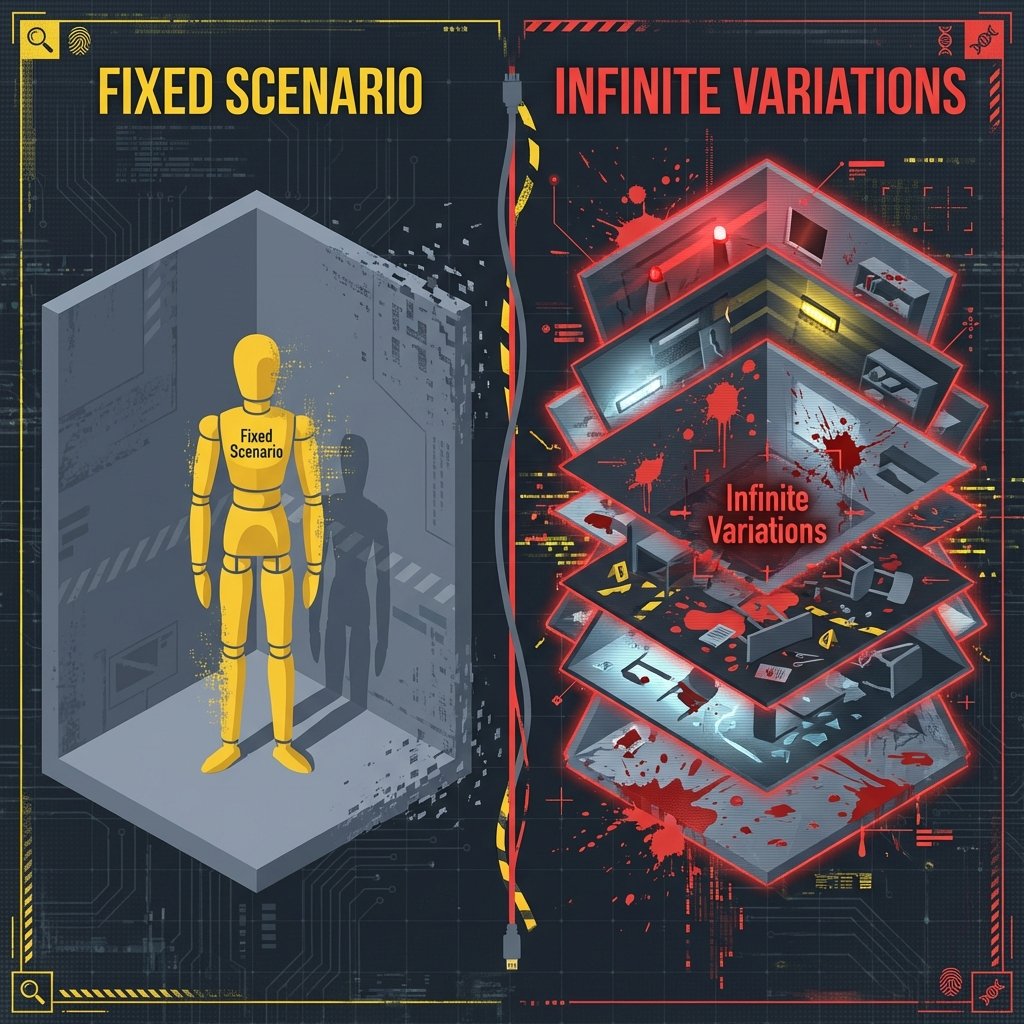
As someone with high-functioning autism, my brain naturally seeks the patterns in the noise. I've always found that high-fidelity visuals help me "lock in" the underlying logic of a complex system. When I can see the secondary and tertiary details—the way a rug is slightly bunched near a doorway, or the specific angle of a broken motherboard on a desk—I can start to trace the "Ins and Outs" of the event. To a untrained eye, these are just pixels. To an investigator, they are a message written in the language of entropy. By using tools like Midjourney and the specialized Nano Banana framework, we can generate scenes that challenge an officer's ability to see through the noise and identify the core truths.
Tactical Insight: The Forensic Prompt Architecture
To generate high-authority training scenarios, we must move beyond the "vibe" and into the technical specification. Simple prompts like "a dark crime scene" lead to generic, cinematic clichés that have zero training value. To truly test a trainee's ability to identify evidence continuity, we need Prompt Structuring that defines the architectural lie within the scene.
"Generate a technical floorplan for a residential breach with 3 entry points, prioritizing the 'path of least resistance' for a 1980s-era lock system. Render in high-contrast orthographic view."
"/imagine prompt: Photorealistic overhead view of a disheveled home office, 2026 electronics, intricate cabling patterns, subtle thermal signatures on the keyboard, --v 6.1 --style raw --ar 16:9"
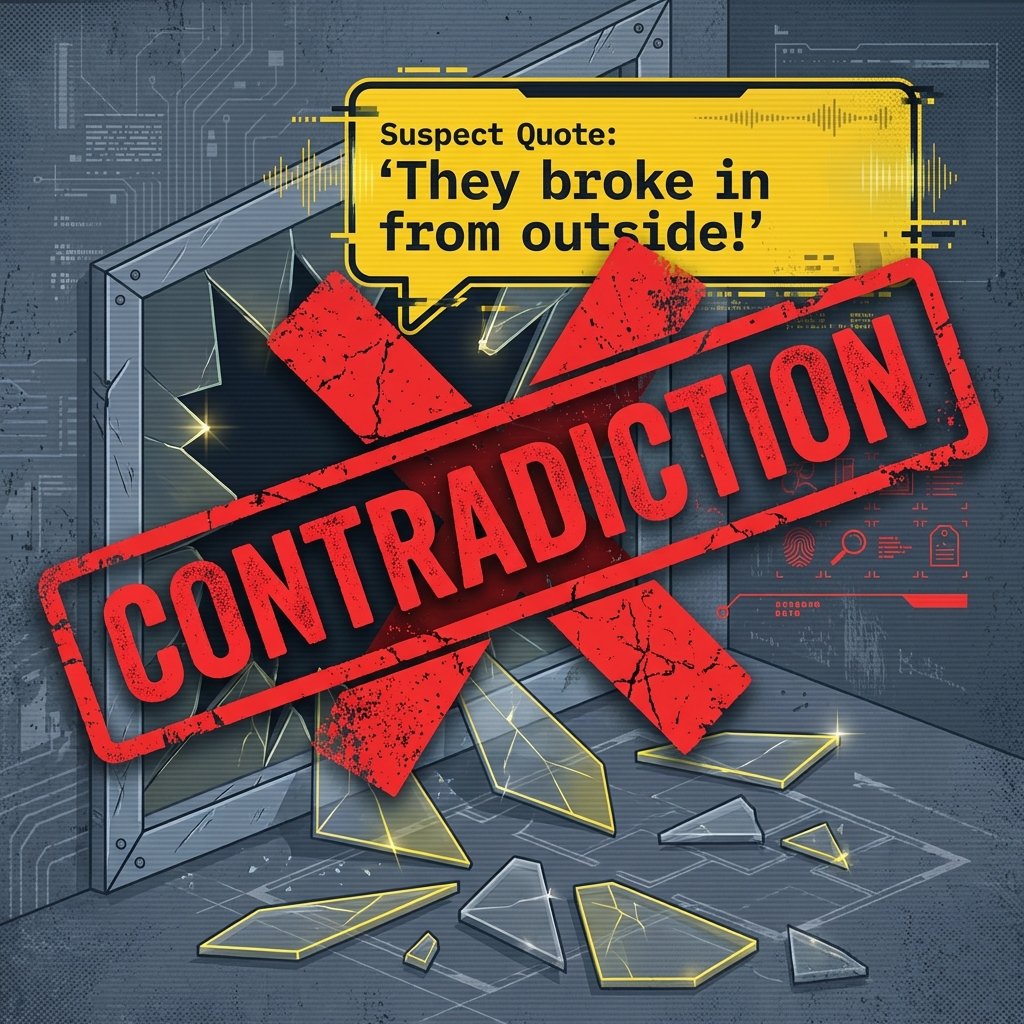
"Create a visual scene where the physical evidence (broken window glass on the INSIDE) contradicts the suspect's claim of an external entry. Test the trainee's ability to spot the discrepancy."
The Science of Synthesis: Latent Space & Denoising Logic
Many people think AI "searches" the internet for images to mash together. That is a fundamental misunderstanding of the technology. AI operates within a Latent Space—a high-dimensional mathematical map where every concept the model has "learned" is stored as a vector. When you input a prompt, you are not searching; you are steering. You are providing the coordinates for the model to navigate toward. If you prompt for "blood spatter," the model identifies the mathematical relationship between liquid dynamics, surface tension, and biological colors within that map.
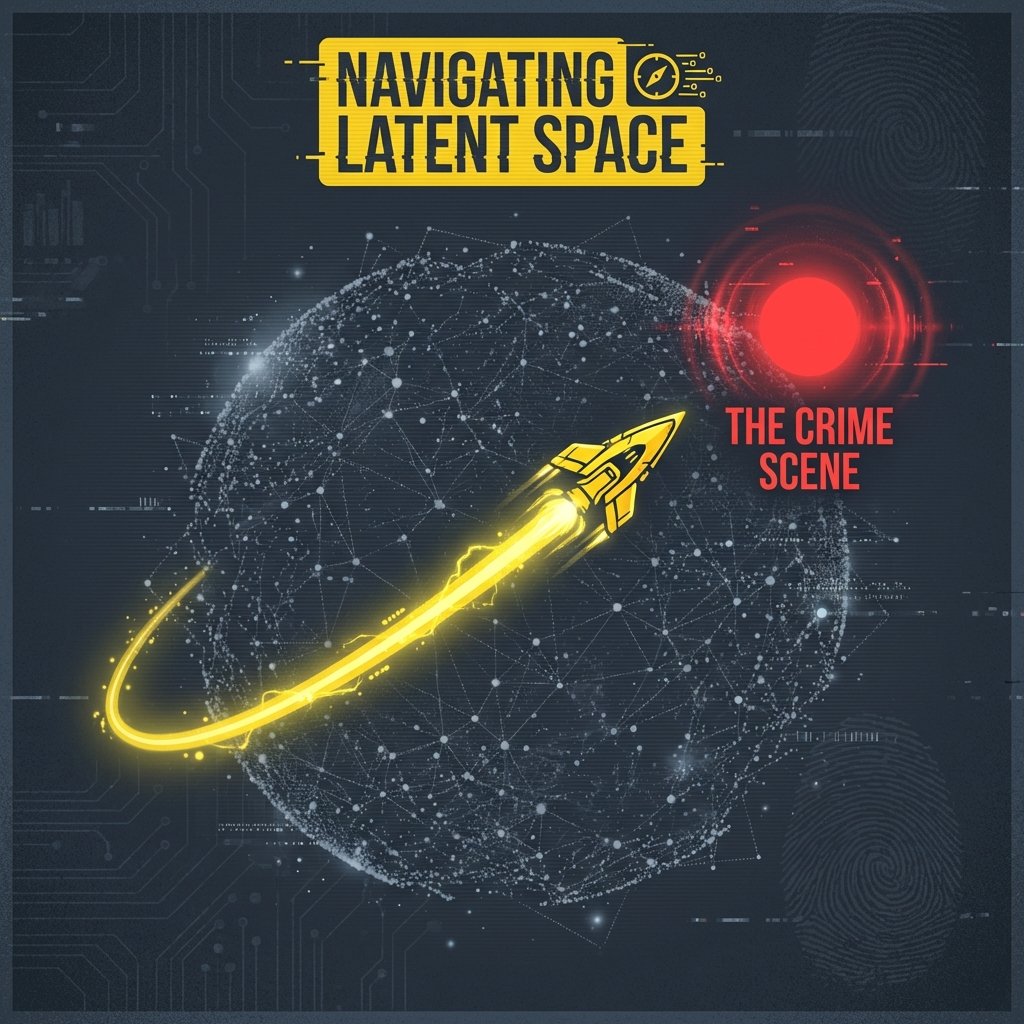
The process of actual generation is called denoising. Imagine starting with a screen filled with pure static—random noise with zero structure. The Diffusion model then performs a sequence of mathematical operations, gradually removing that noise (denoising) to reveal the image that matches your prompt's vector. Each "step" in the generation process pulls the static closer to the ground truth of your request. This process mirrors the finest investigative work: we start with the chaos of a crime scene and systematically remove the noise until only the factual evidence remains.
By understanding the weights and biases of the model (the internal "importance" it gives to certain features), we can refine our training scenarios. If the model is too "clean," we increase the chaos parameter to introduce realistic clutter. If we need absolute photorealistic fidelity, we leverage Black Forest Labs' The Venice AI Image Generation Suite models, which have redefined the state-of-the-art in open-weights image generation. Whether you use Midjourney or The Venice AI Image Generation Suite, the goal is to master the "Latent Logic" of the scene.
Reconstruction & The Digital Paper Trail
The power of AI in law enforcement isn't limited to just generating 2D training images. We are entering the era of automated scene reconstruction. By feeding physical evidence data and spatial descriptions into a multimodal AI, we can generate 3D walkthroughs or high-fidelity "alternate views" of a scene. This allows investigators to test theories of movement and entry in a virtual sandbox before committing to a final report. It's about visualizing the "Potential Path" based on the data points we've recovered.
Furthermore, Large Language Models (LLMs) can now generate evidence logs and incident reports that perfectly sync with the generated visuals. Imagine a training module where the student receives an AI-generated photo of a crime scene AND a corresponding 10-page Incident Report. The student's task is into find the discrepancy—to identify where the written report contradicts the visual evidence. This builds cross-modal literacy, a skill that is becoming mandatory as digital and physical forensics merge.
This holistic AI workflow is the endgame of the "Ins and Outs" philosophy. We aren't just using tools; we are building an integrated intelligence stack. We use Midjourney for the visual In, an LLM for the textual In, and the human investigator's brain for the analytical Out. This is augmented policing at its most effective.
Variations, Bias, & The Cognitive Shield
One of the most insidious threats to justice is cognitive bias. Humans are wired to see what they expect to see. If an investigator has worked ten burglaries where the perpetrator entered through a back door, they will subconsciously look for evidence of a back-door entry on the eleventh. This is confirmation bias, and it ruins cases. AI provides a cognitive shield against this by allowing for massive variations in training.
We can take a single "crime" concept and generate 100 variations of the scene. In some, the evidence is obvious; in others, it is obscured by environmental noise or red herrings. This forces the trainee to abandon their assumptions and rely purely on investigative methodology. They can't "game" the test because the data is fresh every time. By flooding the training cycle with high-quality, varied data, we are effectively de-biasing the human investigator through exposure therapy.
This is more than just tech; it is a service to the community. By improving the rigor of training, we are serving the mission of organizations like the National Institute of Standards and Technology (NIST) and local departments globally. We are helping ensure that the search for truth is as accurate and unbiased as possible. By the grace of God, we have been given the tools to see more clearly; it is our responsibility to use them.
Serving the Truth-Seeker: The Human Anchor
As a follower of Jesus Christ, I believe that truth is not just a preference; it is a fundamental requirement for a just society. "The truth shall set you free" is more than a quote; it is a forensic principle. When we use AI to create better training for officers, we are serving their mission to protect the innocent and identify the guilty. We are helping them build the "mental circuitry" required to navigate the high-pressure environments where split-second decisions change lives.
However, we must always maintain the human-in-the-loop safety rule. AI is a powerful tool for reconstruction and visualization, but it is not a "magic button" for truth. Every AI-generated scenario must be anchored by a human expert who verifies its logical consistency and forensic accuracy. We are building the Rosetta Stone of modern forensics, not an automated judge. AI provides the scale, but humans provide the judgment.
My journey from scavenging computer parts in rural Rural Wisconsin to architecting AI workflows has taught me that every scene—physical or digital—is a message. If we lose the ability to read the message, we lose the ability to provide justice. These AI-generated mock crime scenes are the training ground for the next generation of truth-seekers. Master the prompt, master the scene, and you will move closer to the truth.
The path to mastery is iterative, demanding, and ultimately, a service to our fellow man. Whether you are a cadet, a veteran investigator, or a tech enthusiast, understanding the "Ins and Outs" of visual synthesis is the key to navigating the 2026 digital landscape with integrity and precision.