The Precision Artisan: Engineering with Intent
In the landscape of Large Language Models, if OpenAI is the boisterous socialite, Anthropic's Claude is the introverted scholar. Precision isn't just a preference—it’s a requirement for high-level engineering. When I was scavenging the electronic bins of the Rural Wisconsin dump as a kid, I wasn't just looking for parts; I was looking for the ones that fit a specific, high-tolerance logic. I needed to know exactly how a component would behave under load. That same "scavenger logic" is what drew me to the latest frontier: Claude 4.5 Sonnet. Developed by Anthropic—a company founded by former OpenAI executives, specifically the Amodei siblings—Claude represents a choice for those who value Helpful, honest, and harmless intelligence over raw, unaligned power.
This founding team left to focus specifically on a more disciplined approach to AI Safety. Their mission wasn't just to build a faster model, but a more stable one. For a developer in rural Minnesota, where resources must be managed efficiently, the Claude lineage—culminating in Claude 4.5 Sonnet and Claude 4.5 Opus—has become the "daily driver." These models are famous for their Superior Performance in Coding and Complex Reasoning. It doesn't just guess what you want; it identifies the Weights and Biases of your intent and executes with a level of rigor that mirrors a senior software architect.
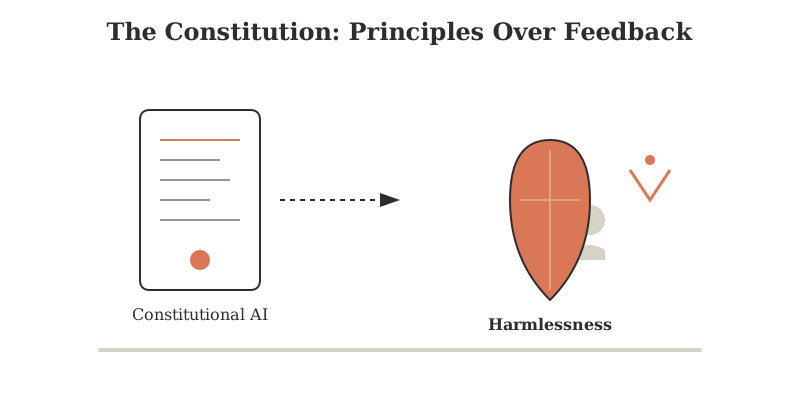
The core differentiator here lies in the architecture of alignment. While other models rely heavily on broad RLHF (Reinforcement Learning from Human Feedback), Anthropic's safety methodology is called Constitutional AI. This is a breakthrough in AI Alignment. Instead of just learning from human ranking, the model is trained to follow a fixed "Constitution" of principles—a set of rules it must never violate. This makes Claude particularly good at avoiding hallucinations and unsafe content, providing a level of Grounding that is essential when you're building production-ready code.
Inside the Artifacts: The Parallel Reasoning Window
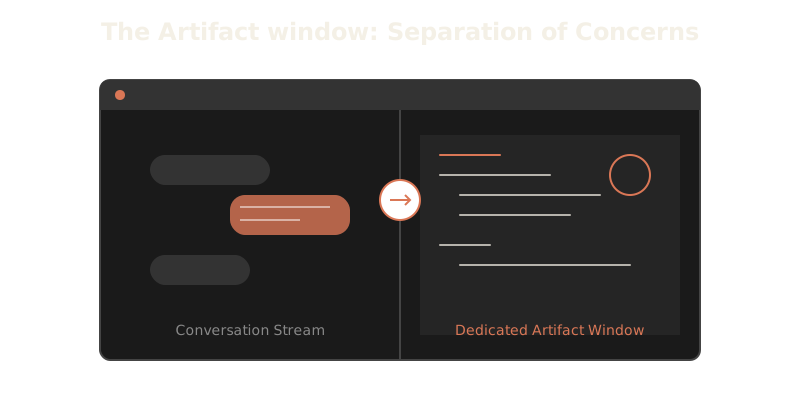
One of the most significant UI innovations in the AI era is the Claude Artifacts interface. 'Artifacts' in the Claude interface describe a side-by-side window for code, documents, and website previews. This isn't just a gimmick; it’s a shift in Cognitive Workflow. For years, we’ve been hampered by the "chatbox" paradigm, where you have to copy-paste code back and forth. Artifacts allow the AI to manifest its internal Logic Processing in a dedicated visual area, enabling a seamless feedback loop.
When I’m architecting a new React component or debugging a complex Python environment, I can see the code evolve in real-time. It mimics the feeling of my early days troubleshooting motherboard issues in Rural Wisconsin—you adjust a setting, you watch the diagnostic light, you refine. This Parallel Generation makes Claude the ultimate tool for Vibe Coding. You provide the intent, and Claude provides the implementation in a clean, isolated Development Sandbox.
This visual clarity is backed by a massive 200k context window. Claude was a pioneer in long-context windows, allowing users to upload entire libraries of documentation, codebases, or legal transcripts. For me, this means I can feed it the entire "ins and outs" of a project and know that the model has the Depth of Context to understand the nuances of the architecture before I even ask my first question. This is the definition of Context Engineering—don't just give it a prompt; give it a world.
The Claude Lineage: From 1 to 4.5
To understand the power of the current state, we must look at the Lineage of Claude. It began with Claude 1, which focused almost entirely on safety and basic helpfulness. It was followed by Claude 2, which expanded the Context Window and improved the model's ability to handle long documents. These early iterations laid the foundation for what would become Anthropic's dominant position in the market.
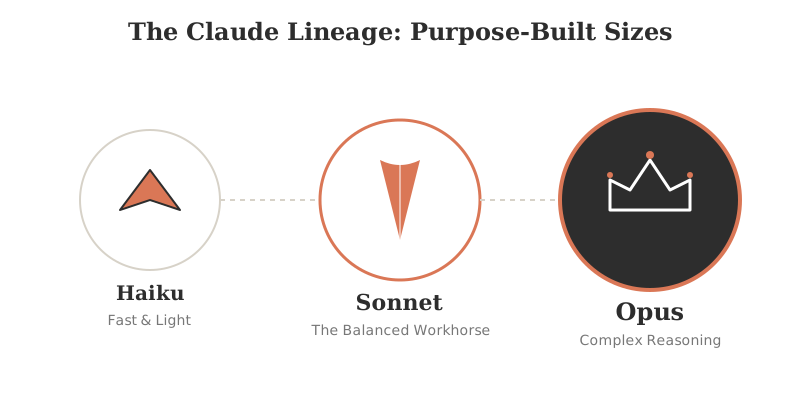
With the release of the Claude 3 family (Haiku, Sonnet, Opus), the parity with OpenAI was reached. Claude 3 Opus was the first to truly challenge the status quo in high-stakes reasoning. But it was the leap to Claude 4.5 that changed everything. Claude 4.5 Opus is now the undisputed champion of Creative Synthesis and Architectural Planning, while Claude 4.5 Sonnet remains the fastest, most reliable surgical tool for Vibe Coding.
You can explore the full technical specs and evolutionary timeline in Anthropic's official model documentation. This document is a masterclass in how Inference can be scaled without losing the "soul" of the alignment.
Finally, for those tasks where volume and efficiency are the primary goals, we still have Claude 3 Haiku. 'Haiku' is the fastest and most cost-effective model in the Claude family, making it perfect for high-frequency Workflow Automation.
Choosing the right model is a "scavenger" skill in itself. In my automation loops—like the ones I built for Thrifty Flipper—I use Haiku to categorize inventory and Claude 4.5 Sonnet to write the System Prompts that govern the entire logic. This Multi-Model Strategy is how you scale intelligence without scaling your costs.
The Ethics of Stewardship
As a follower of Jesus Christ, I am constantly questioning the heart of the "machine." We must never confuse a Logical Engine with a soul. However, the mission of Anthropic to create a model that is Helpful, honest, and harmless is a pursuit of excellence that honors the gifts we’ve been given. Anthropic is backed by significant investments from Amazon and Google, which gives them the Compute Power to continue their research into Interpretability—the science of understanding why an AI says what it says.
Working with Claude 4.5 feels different than working with GPT-4o or Grok. There is a "humility" in the response. It is quick to admit when it doesn't know something, avoiding the Hallucination Problem. This is the result of Constitutional AI. By aligning the model to a set of principles rather than just popularity, Anthropic has created a system that respects the user's need for Atomic Truth.
Stewardship means taking these powerful tools—from the earliest Claude 1 to the latest Claude 4.5 Opus—and using them to build something that lasts. Whether you are using Iterative Refinement to polish a project or using Artifacts to visualize a new PWA, the goal remains Human Agency. We are the pilots; the AI is the navigation system. By the grace of God, we have been given these tools to steward. Let’s make something beautiful.