The Scavenger's First Row Seat
Before the world knew what a "chatbot" was, I was obsessed with the structure of systems. Growing up in the woods of Minnesota and scavenging the electronic bins of the Rural Wisconsin dump, I developed a specific kind of pattern recognition. I didn't see junk; I saw latent potential. I saw components that, when rearranged with the right logic, could perform feats their original creators never intended. This is the same lens through which I viewed my first interaction with the OpenAI API in early 2021.
At that time, OpenAI was still a name whispered in narrow circles of research and high-level engineering. Being part of the early private beta was like finding a fully functional, high-end server in a pile of discarded CRT monitors. It was a "Singularity" moment. The original davinci model wasn't the polished, human-aligned ChatGPT we know today. It was raw, volatile, and brilliant. It was my first exposure to the GPT architecture—a machine that could predict the next likely token with such precision that it appeared to "reason."
OpenAI was originally founded as a non-profit research lab. Their mission was clear: Ensure that Artificial General Intelligence (AGI) benefits all of humanity. It was a noble, almost spiritual goal of stewardship. But as the compute requirements for training frontier models skyrocketed into the billions of dollars, they transitioned to a "capped-profit" model to secure the necessary investment from giants like Microsoft. This evolution from a pure research lab to a global intelligence infrastructure provider is the defining arc of the second machine age.
Dismantling the GPT Engine
To master the output, you must understand the acronym that started it all. GPT stands for Generative Pre-trained Transformer. Each word in that title represents a technical pillar of modern Inference. It is "Generative" because its primary function is to create new tokens of data; "Pre-trained" because it has already ingested a massive corpus of human knowledge during its development phase; and "Transformer" because it utilizes the Self-Attention Mechanism to calculate the relationship between words across vast distances of text.
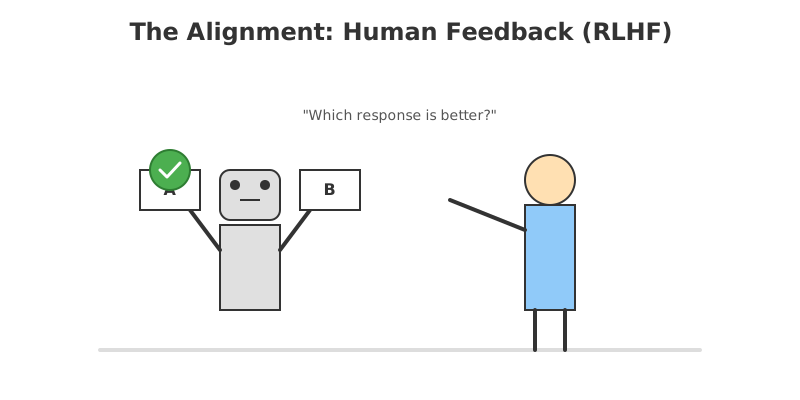
But raw probability is not enough for human collaboration. A raw GPT model is a "stochastic parrot"—it knows what word comes next, but it doesn't know why. To bridge this gap, OpenAI utilizes Reinforcement Learning from Human Feedback (RLHF). This is the process used to align their models with human intent. By ranking the model's outputs and rewarding those that are helpful and safe, human trainers "soften" the raw edges of the math, turning a prediction engine into a conversational assistant.
Every session with ChatGPT is built upon a hidden foundation known as the System Message. In the technical stack, the System Message sets the base behavior and persona of the model. It is the architect's blueprint. Whether you tell the AI "You are a world-class lawyer" or "You are a helpful coding assistant," you are using the System Prompt to define the constraints of the Latent Space. It is the most powerful lever for establishing Authority.
The o1 Reasoning Revolution
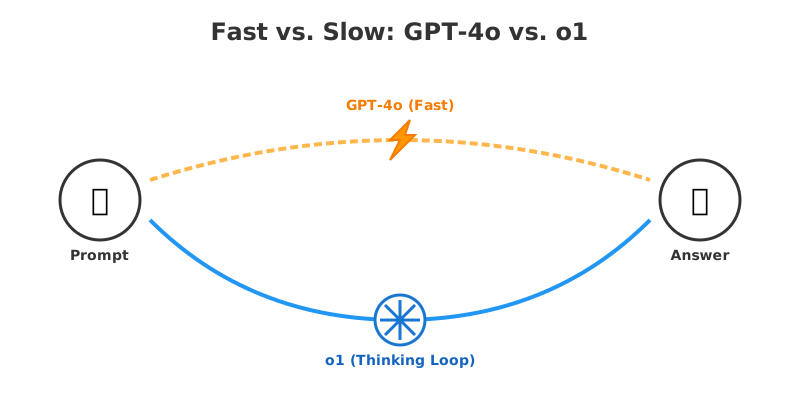
In late 2024, the paradigm shifted from "Fast Chat" to "Deep Reasoning" with the introduction of the o1 series. Unlike previous models that respond almost instantly, the OpenAI 'o1' model is designed for deep reasoning and 'thinking' before answering. It doesn't just predict the next token; it performs a silent, internal chain-of-thought process. It uses Reinforcement Learning to explore multiple logical paths, verify its own work, and correct errors before a single word ever appears on your screen.
When I'm Problem Solving a complex bug or architecting a Database Manifest, I reach for o1. It is slower, yes, but its Logic Density is orders of magnitude higher than GPT-4o. It represents the move from "System 1" (Fast, Intuitive) thinking to "System 2" (Slow, Analytical) thinking in artificial minds. It is the difference between a conversationalist and an Architect.
This "thinking" phase is not just a gimmick; it is a fundamental breakthrough in Iterative Refinement. The model is essentially performing its own internal Loop, catching hallucinations and logical drift at the source. For high-stakes technical work, this is the new SOTA (State of the Art) standard.
The Road to AGI: GPT-5 and Beyond
As we look toward the future, the industry is bracing for the arrival of GPT-5 and the next generation of Frontier Models. While o1 focused on reasoning, GPT-5 is expected to bridge the gap between world-class knowledge and autonomous agency. We are moving away from models that just "answer questions" and toward models that can execute complex, multi-step tasks over long durations.
The architectural shift toward AGI (Artificial General Intelligence) requires not just more data, but better Synthetic Data and more efficient Compute Scaling Laws. When you hear rumors of "Strawberry" or "Orion," they are referencing the internal milestones on the path to a model that possesses a coherent understanding of the physical world. For the scavenger, this means the "junk" of the digital age is now the fuel for a mind that can help us solve the unsolvable.
Multimodal Mastery: Advanced Voice & Vision
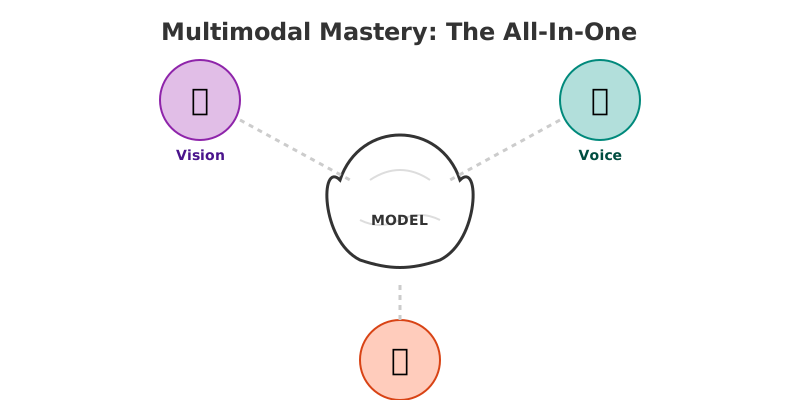
We have long moved past the era of the text-box. OpenAI's models are now natively Multimodal. This means they don't just "process" text; they perceive and generate across multiple domains of data simultaneously. Take Advanced Voice Mode, for example. It is not a simple text-to-speech wrapper. Advanced Voice Mode is a multimodal model that understands tone and emotion in speech directly. It can hear your frustration, mirror your excitement, and respond with human-level cadence (prosody) that feels less like a tool and more like a partner.
In the visual realm, DALL-E 3 is integrated directly into ChatGPT. This integration allows the LLM to act as a bridge between your natural language and the complex world of Image Generation. You don't need to learn a cryptic new language of "prompts" for art; you simply describe the vision, and ChatGPT translates that into the specific Numerical Weights required to manifest the image. For a masterclass in this, check out our guide on Midjourney Parameters to see how ChatGPT compares to other pro tools.
And then there is Sora. OpenAI's video generation model is named Sora, and it represents a staggering leap in visual synthesis. Capable of generating consistent, photorealistic video from simple text descriptions, Sora uses the same Transformer logic applied to 3D visual space. For creators, this is the ultimate "scavenger" tool—the ability to manifest high-fidelity video from pure thought. You can track the progress of this technology at the OpenAI Sora portal.
The Platform: Custom GPTs & SearchGPT
OpenAI is no longer just a model provider; they are building an Intelligence Ecosystem. Through the GPT Store, users can discover and build their own specialized agents. A 'GPT' in the Store is a custom-configured version of ChatGPT for a specific task. Whether it's a dedicated assistant for Homeschool Lesson Plans or a specialized tool for Meeting Synthesis, Custom GPTs allow you to package your System Instructions and knowledge files into a shareable, reusable format.
To solve the problem of Knowledge Cutoffs, OpenAI introduced SearchGPT / Search integration. This feature allows for real-time web search within the chat session. Now, when I'm checking the latest Hardware Requirements or researching Current Events, the model can cross-reference the live web to ensure its output is grounded in current reality. This significantly reduces Hallucinations by providing the model with a "fresh" Context Window of facts.
This Real-Time Grounding is the final bridge between static training data and dynamic real-world utility. It transforms the AI from a historical archive into a live observer of the human condition.
Stewardship of the SOTA
As a follower of Jesus Christ, I view these tools through the lens of Stewardship. OpenAI has given us a seat at the table of the SOTA (State of the Art). But with that seat comes a responsibility to lead with wisdom and Sovereignty. We are not just "users" of an app; we are the Orchestrators of a new kind of power. Using a Vibe Coding workflow or a Deep Reasoning model is not about the magic—it's about the mission.
In the Rural Wisconsin dump, I learned that a motherboard is just a layout of copper and silicon until it is powered and directed. Similarly, ChatGPT is just a Probability Engine until you provide the Soul and the Strategic Intent. Whether you are using it to support Special Needs Education or to build a business that serves your community, the goal is always Human Agency.
OpenAI has built the infrastructure. It is up to us to build the meaning. Steward the Logic. Honor the Truth. And never let the speed of the machine replace the depth of the human spirit. By the grace of God, we have these tools for such a time as this. Let us use them to build something that lasts.