The Everywhere Agent: Context Without Borders
In the landscape of Large Language Models, Google Gemini isn't just another chatbot; it is a fundamental shift in how we perceive global information orchestration. When I was a kid in Rural Wisconsin, scavenging for electronic parts at the local rural dump from age 11 to 20, I learned that the most valuable components weren't the ones that looked the fanciest—they were the ones that could be integrated into the largest systems. I needed parts that would play well with others. That "scavenger logic" is why I am so obsessed with Google Gemini. It is the invisible hand of the AI era, living exactly where your work already exists—inside Google Docs, Google Sheets, and Gmail.
The project was born from the historic merger of DeepMind and Google Brain—creating Google DeepMind, the lab tasked with building a model that could compete with the world's most advanced reasoning engines. What they produced was Gemini, a model that is natively Multimodal. This means it wasn't just "trained on text" and then had images "bolted on" later. From day one, it was built to understand text, image, audio, and video as part of the same conceptual framework. This native multimodality allowed Gemini to perform tasks that were previously impossible, like analyzing live video streams or interpreting complex technical diagrams as if they were simple paragraphs.
In my own workflows, specifically with Thrifty Flipper and the Ins and Outs project, the biggest source of "cognitive sludge" has always been the context switch. Moving from your data to your AI and back again. Google Gemini removes this barrier. By integrating directly into Google Workspace, it acts as a permanent, high-intelligence sidekick. Whether you are drafting a complex strategy document or summarizing a hundred-email thread from a vendor, Gemini handles the noise so you can focus on the signal.
The Context Giant: From 2 Million to the Gemini 3 Era
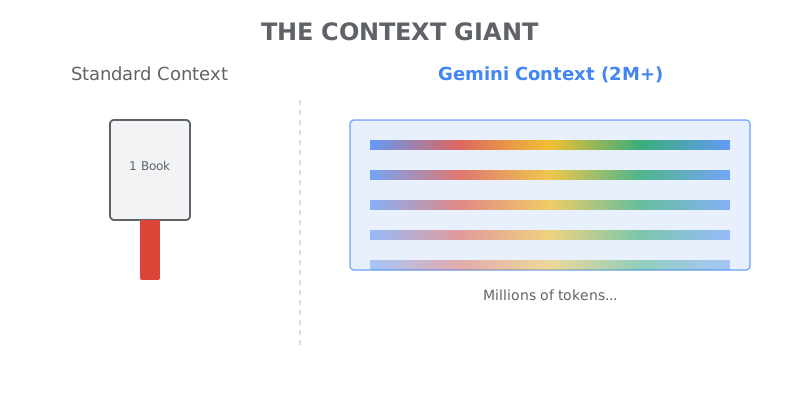
If there is one technical specification that defines the "Gemini Era," it is the massive context windows that began with the 2 Million token benchmark in Gemini 1.5 Pro. To put that in perspective, while other models might struggle to remember the beginning of a short book, these models can digest entire codebases, thousands of pages of legal documentation, or even hours of high-definition video in a single request. This isn't just a "larger memory"; it is a new paradigm for Context Engineering.
When I was examining the logic for Antigravity, a tool that sits atop the agentic coding field, I found that the traditional RAG (Retrieval-Augmented Generation) methods—where you chop up a file into tiny pieces—often lost the "soul" of the code's hierarchy. With Gemini, you don't need to chop. You can feed it the whole stack. Gemini is a master of Inference at scale, allowing it to maintain perfect coherence across a massive logical surface area. This capability is what allows Gemini to analyze video by processing raw frames and audio as tokens within its window, effectively "watching" a movie to find a single, specific detail.
Now, with the arrival of Gemini 3, the boundaries of reasoning and efficiency have been pushed even further. Gemini 3 Pro represents the new baseline for elite reasoning, capable of handling multi-step logical leaps that previous generations could only approximate. For high-frequency environments, Gemini 3 Flash provides a radical speed-to-intelligence ratio, making real-time orchestration a reality for complex agentic workflows. These join the established family: Ultra for extreme reasoning, and Gemini 'Nano', which is still designed for on-device processing for mobile and local PC tasks, ensuring your most sensitive data never has to leave your control.
NotebookLM: Grounded Intelligence
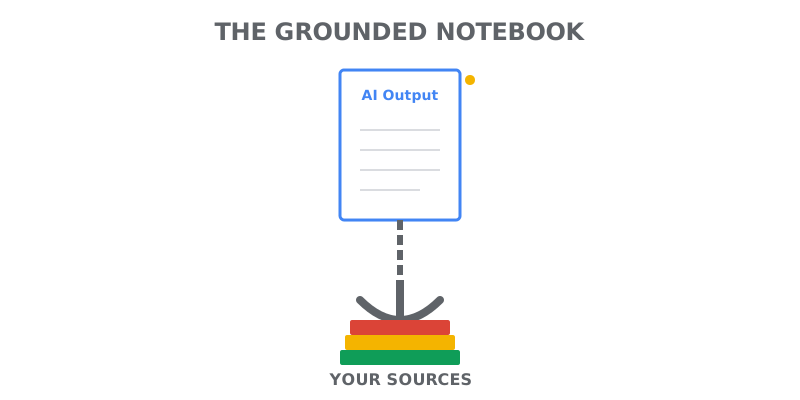
Perhaps the most practical implementation of the Gemini model to date is NotebookLM. NotebookLM uses Gemini to provide grounded, source-based analysis of your files. It is a research beast. Instead of just "knowing everything on the internet," you can create a "Notebook" filled with your specific PDFs, web links, and internal notes. The AI is then "grounded" in that specific data.
This is a massive defense against the Hallucination Problem. Because the AI is forced to cite its sources from within your private library, you can verify every claim it makes. I use this extensively when synthesizing data on complex topics across multiple fields. For example, I’ve used it to cross-reference the geopolitical effects on cryptocurrency markets with historical data on how hyperinflation and currency collapse lead to direct reductions in enforcement capacity. I can dump disparate research papers, economic datasets, and geopolitical reports into NotebookLM and ask it to find the intersection of these forces. It doesn't just give me a theory; it gives me the exact page number and paragraph where the evidence lives. This is the definition of high-integrity, cross-disciplinary research.
Gemini also features a powerful safety mechanism called 'Grounding with Google Search'. This feature allows Gemini to verify its answers against live web data in real-time. If the model feels it might be drifting into uncertainty, it cross-references the live index of the world's information. This transparency is a key part of Google's push for responsible AI, ensuring that users have the tools to discriminate between machine-generated prose and grounded, verifiable truth.
Antigravity and the Agentic Future
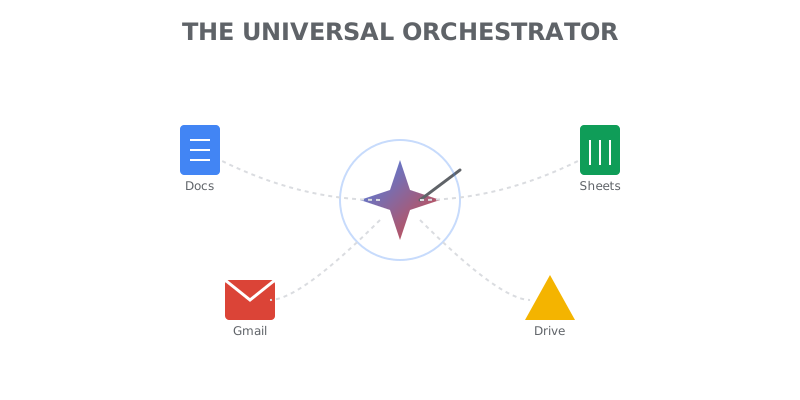
Sitting atop the agentic coding field are ecosystems like Antigravity. This isn't just about a model that "talks" to you; it’s about a system that has the Action Potential to change the world. By leveraging Google Gemini's advanced function-calling capabilities, Antigravity can navigate a filesystem, execute code, and even manage browser instances to perform research tasks autonomously.
For developers engaged in Vibe Coding, this is the holy grail. You don't just provide a System Prompt; you provide a mission. The model then uses its internal Weights and Biases to navigate the path toward that goal. Whether you are using a Gemini-powered IDE or an autonomous agent for Workflow Automation, the goal remains the same: leverage. We take the massive compute power of Google DeepMind and use it to amplify our own human agency.
The multimodal nature of these agents means they can "see" your UI, "hear" your voice commands, and "read" your code simultaneously. It is a comprehensive integration that mirrors the way we solve problems in the real world. We don't just look at code; we look at the UI, we listen to the bug report, and we research the documentation. Gemini is the first platform that truly enables this unified multisensory approach to engineering.
The Ethics of Universal Stewardship
As a follower of Jesus Christ, I am constantly reminded that with great power comes the obligation of stewardship. Having access to the collective knowledge of humanity through Google's infrastructure is a gift, and it must be used for the benefit of our neighbors. The memory of friends like TJ Beach drives me to ensure these tools are used to solve real problems—like educational gaps for special needs children or increasing the throughput of local businesses.
The DeepMind legacy is one of "solving intelligence" to solve everything else. But stewardship also requires discernment. Because Gemini is so deeply integrated with your Google account, you must be extremely intentional about your data privacy. In our tutorials on Data Sovereignty, I emphasize the use of Gemini Nano for local processing whenever possible. We must balance the convenience of a universal AI ecosystem with the absolute requirement for personal privacy and control.
Google Gemini is the utility player of the AI world. It's the 10-in-1 tool for the modern information worker. By the grace of God, we have this massive compute at our disposal. Whether you are using it for long-context document synthesis or multimodal reasoning, use it to clear the weeds, so you can plant the seeds of your true calling. Let’s make something that outlasts the machines.