The Art of the Pushback: Why First Drafts Fail
The biggest mistake people make in the age of AI is a failure of persistence. Most users treat the machine like a search engine—expecting a perfect, single-shot answer from a single-sentence query. But in the world of high-authority Large Language Models (LLMs), the first response is rarely the final one. Why? Because complex tasks require multiple "passes" to refine logic, eliminate hallucinations, and polish the details.
Intelligence, whether human or machine, is an Iterative Process. When I was thirteen, scavenging for the "ghost" in the machine at the Rural Wisconsin dump, I didn't just find a part and assume it worked. I had to clean the contacts, test the continuity, and often, push back against the initial failure or poor performance. I learned that Inference—the technical term for the model's "thinking" phase—is a dialogue. If you accept the first draft, you are accepting the "average" of the model's training data. To reach excellence, you must enter The Loop.
Iterative Refinement is the formal process of reviewing the machine's "Out," identifying the patterns that are weak or factually drifting, and providing the corrective "In" to guide the next generation. It is the act of Sculpting the software or the narrative in real-time. It is where your human discernment transforms probabilistic output into a definitive Inference session that reflects your unique vision.
The Feedback Loop: The Engine of Authority
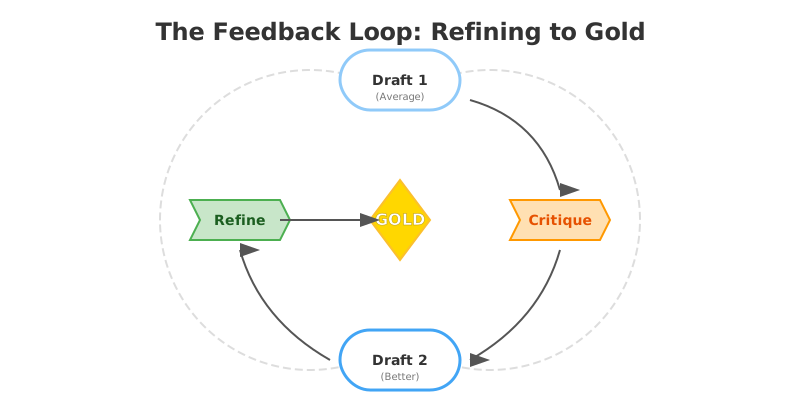
At the heart of this technique is the Feedback Loop. This isn't just a generic term; it is the process of reviewing output, giving corrections, and generating a new version. It is the "AI Dance" where you and the machine collaborate to resolve complexity. When the model outputs a paragraph that feels too "AI-sounding"—full of generic adjectives and safe conclusions—you don't delete it. You refine it.
Your feedback must be technical and high-density. Instead of saying "make it better," you analyze where the pattern broke down. Did the model lose the thread of its System-Level Persona? Did it hit a Context Window limit? If an AI fails a task, your job is to analyze "Where" it failed and provide more specific context or constraints.
In my work on project like Thrifty Flipper, I often find that the first pass on a pricing algorithm is far too optimistic. I have to push back: "The market velocity calculation is ignoring the 15% platform fees. Recalculate the net profit margin constraint using the revised fee structure provided in the Manifest." This Targeted Feedback is the spark that moves the model from generic reasoning to professional precision.
Decomposition: The Multi-Prompt Strategy
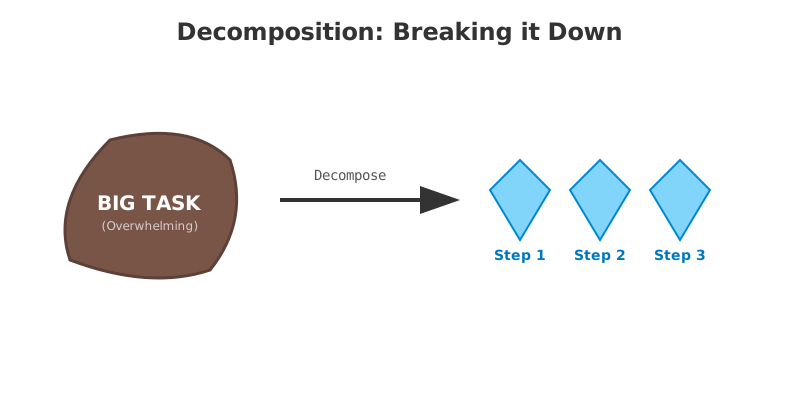
When a task is massive—like building a 1200-word module or architecting a database—a single prompt is a recipe for failure. The more variables you ask the AI to handle at once, the more likely it is to experience Logical Drift. This is why a "Multi-Prompt" approach is better for complex tasks that can be broken down into smaller, manageable steps.
Think of it like building a custom PC from salvaged parts. You don't just dump all the parts together and hope they form a machine. You build the Foundation (the motherboard and CPU), then you test the Memory (RAM), then you add the Storage and the GPU. Each step is a discrete loop of work and verification.
In Prompt Engineering, this is called Decomposition. You prompt for the outline first. You refine that outline until it's perfect. Then, you prompt for Section 1. You refine Section 1. You prompt for Section 2, but you provide Section 1 as Context so the model maintains continuity. This Sequential Reasoning ensures that the model's attention is always focused on an area small enough to maintain 100% accuracy.
Recursive Prompting: The AI as its Own Critic
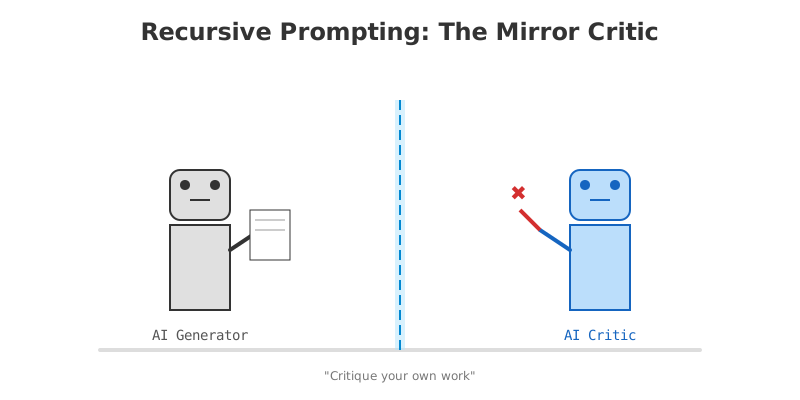
One of the most powerful and underutilized refinement techniques is Recursive Prompting. This involves asking the AI to review its own previous output for errors or improvements. It is a form of Self-Correction that often catches nuances that a tired human eyes might miss.
You can prompt the model: "Review the draft above. Identify any areas where the tone deviates from the established technical persona. Find three specific logical inconsistencies in the market velocity section and suggest a fix for each." By shifting the model's role from "Creator" to "Critic," you leverage its pre-trained knowledge of grammar and logic to perform a second pass on itself. This results in a massive jump in Confidence and factual density.
This method is highly effective for Weight Alignment. You are essentially forcing the model's statistical engine to compare its output against a set of high-integrity benchmarks. If the model can't defend its own logic, it shouldn't be in your final product.
Prompt Weighting: Focusing the Attention
During the refinement phase, you often need to steer the model toward a specific keyword or idea that it's neglecting. This is Prompt Weighting—the act of emphasizing certain keywords or instructions to guide the model's focus. While models don't have feelings, their Attention Mechanisms are highly sensitive to word frequency and structural placement.
If the AI is ignoring your privacy constraints, don't just repeat the instruction. Weight it. Use Markdown headers, use all-caps for critical constraints (e.g., "CRITICAL: No data must leave the local environment"), or use delimiters to isolate the instruction. You can even use numerical weighting in some advanced interfaces to tell the AI exactly how much importance to give a specific token.
By Weighting your intent, you ensure that the machine's Probabilistic Drift is pulled back toward your Sovereign Strategic Guidance. You are the director of the scene; the weights are the lighting. You decide what the model sees first.
Version Control: Managing the Evolution
A professional refinement workflow requires Version Control. This means keeping track of different iterations (v1, v2, v3) of a prompt or code. In my years of fixing salvaged hardware, I learned that sometimes a "fix" actually breaks two other things. If you don't have a way to Rollback to the previous working state, you've lost your foundation.
When you are refining a complex prompt, keep a log. If "Refinement v4" makes the AI too verbose, you need to be able to see what you added in v4 compared to the successful v3. This is how you find the Delta of Failure. Professional tools like Google Antigravity, Cursor, or GitHub Copilot integrate this into the UI, but even a simple text file of your prompts can act as your Versioned History.
By maintaining a history of your refinement, you aren't just getting a better answer; you are building a Knowledge Base of what works for your specific domain. You are documenting the Success Patterns of your collaboration with the machine.
Reaching the Golden Prompt
After multiple loops of Diagnostic Review, Targeted Feedback, and Recursive Integration, you will eventually reach the Golden Prompt. This is the final, most effective version of a prompt after many refinements that consistently delivers the high-authority results you need.
The Golden Prompt is the reward of the Iterative Refinement process. It is a specialized tool—a refined piece of "code" written in natural language—that can be reused, shared, and scaled. For the Thrifty Flipper project, my Golden Prompt for daily inventory analysis is the result of over fifty iterations. It now handles cross-platform price scraping, fee calculation, and condition assessments with 100% reliability.
Confidence is high when the output passes automated tests and human "Vibe" checks. When the machine's output aligns perfectly with your Mental Model and the "lines" you see in your mind, the loop is complete. You have achieved Alignment.
Summary: Stewardship of the Loop
Iterative Refinement is not a chore; it is a Sanitary Requirement for professional work. It is how we ensure that our tools serve our vision rather than poisoning it with the generic averages of the internet. Because of my high-functioning autism, I am sensitive to the Logic Density of a system. I can "feel" when a draft is shallow or drifting. Refinement is the tool I use to anchor it back to the truth.
Always remember the path: Start with an Architectural Prompt. Enter the Feedback Loop. Use Decomposition for complexity. Leverage Recursive Coaching for quality control. Weight your Strategic Intent. And never stop until you reach the Golden Prompt.
By the grace of God, we have been given the ability to direct these massive engines of probability. But the machine provides the speed; you provide the Soul. Stay in the loop until the vision is manifest. Let the patterns connect. Let the authority shine through.