The Genesis of Intent: Beyond the Syntax Barrier
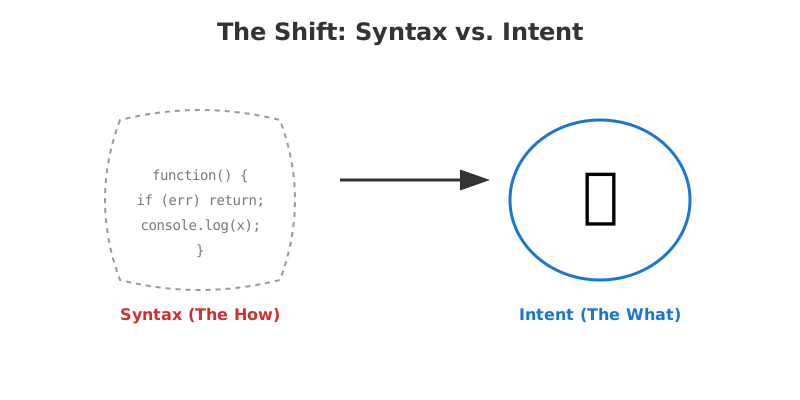
In the traditional era of software development, the machine was a gatekeeper. To build, you had to speak its language—a rigid, unforgiving dialect of brackets, semicolons, and memory offsets. If you missed a single character, the logic collapsed. For those of us with autistic pattern recognition, this syntax was often a distraction from the true beauty of the system: the Architectural Flow. Vibe Coding is the realization that the barrier between human intent and machine execution has finally dissolved.
What is Vibe Coding? At its core, it is using natural language and intent to direct AI to build software. It is a shift from "How" to "What." Instead of manually typing out every hook and handler, the developer acts as a System Architect and Intent Engineer. You aren't "writing" code; you are Directing a high-intelligence agent that has already been trained on massive amounts of code and documentation.
When I talk about the "Vibe," I'm not being poetic. In this technical context, the "Vibe" refers to the broad outcome, design logic, and user experience intent of the project. It is the Semantic North Star that guides the AI's probabilistic generation. When you master the vibe, you aren't just getting code that runs; you are getting software that aligns with the "lines" you see in your mind.
Evolutionary Blueprint: The Thrifty Flipper Case Study
My most profound experience with this shift occurred in late 2025. I set out to build Thrifty Flipper, a real-time inventory and market velocity tool designed for the high-end secondary market. In the 2024 paradigm, this would have required a team of three and a six-month roadmap. I built it as a Sovereign Creator using the principles of Vibe Coding.
I started by using Google Antigravity, an AI-agentic IDE, to vibe code a Progressive Web App (PWA). I didn't start with a database schema; I started with a Manifesto. I described the "struggle" of the user: a person standing in a dusty thrift store, holding a rare 1980s electronics component, needing an instant "Go/No-Go" decision based on live sales data. I described the "vibe" as "Tactical, Fast, and Unforgivingly Accurate."
Because I had used system-level descriptions of the data flow—visualizing the connection from the camera scanner to the API and back to the glassmorphic dashboard—the AI was able to generate the skeleton of the PWA in hours. Once the PWA was stable, I used PWA Builder to wrap my logic into a native-ready package. Today, Thrifty Flipper is a fully functional Google Play Store app. This wasn't achieved through superior typing speed; it was achieved through Superior Architectural Intent.
The Vibe Coding Workflow: Sculpting in Real-Time
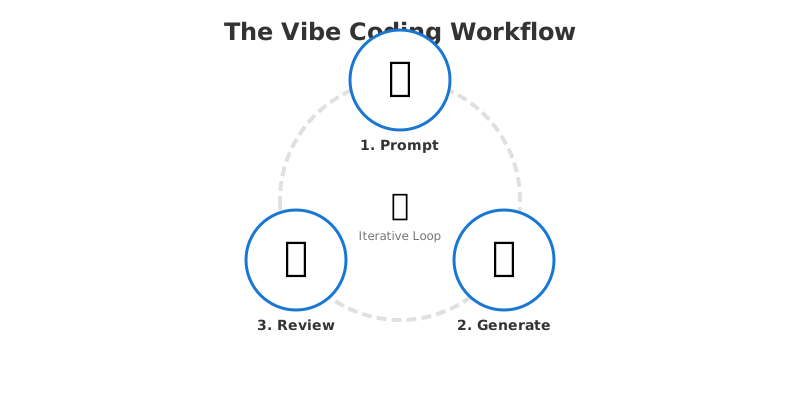
Vibe Coding is an Iterative Refinement process. It is a dialogue between the human's Creative Vision and the machine's Execute Logic. This process is often called Iterative Sculpting—the act of continuously refining an AI's code through natural language feedback. You describe a feature, the AI generates a candidate, you observe the "vibe," and you provide the corrective signal.
The core rhythm of this workflow is the Prompt-Edit Loop. This involves describing a change, letting the AI apply it, and verifying the 'Vibe' matches your mental model. If the dashboard is too cluttered, you don't hunt for CSS selectors; you type: "The information density is overwhelming. Simplify the grid, prioritize the Profit Margin metric, and let the rest breathe." You are sculpting the software in real-time.
This does not mean that Vibe Coding requires NO technical knowledge. On the contrary, while the AI handles the syntax, the human remains responsible for Logic, Architecture, and Debugging. You must still understand how the lines connect. If the database isn't updating, you need to know enough to point the AI toward the Inference Bottleneck or the API Endpoint. The machine is the engine, but you are the Director.
The Workspace of the Future: AI-Integrated IDEs
Where does this happen? The primary workspace for the vibe coder is the AI-Integrated IDE. Tools like Cursor or VS Code with advanced AI extensions are the standard. These aren't just text editors; they are Collaborative Environments where the AI has a constant view of your entire codebase. It sees the Context Window of the whole project, not just a single file.
In these environments, Vibe Coding becomes seamless. You can highlight a block of legacy code and say, "This feels heavy. Refactor it using modern patterns and make sure it handles errors with individual toast notifications." The AI doesn't just suggest a line; it rewrites the logic while maintaining the Architectural Integrity of the system. This allows for a level of Creative Velocity that was physically impossible just two years ago.
By leveraging these tools, we are essentially offloading the Cognitive Burden of syntax. I don't need to remember how to implement a specific debounce function in React for the hundredth time. I need to remember why we need to debounce—to protect the API from the frantic searching of a user in a high-speed resale environment. The "Why" is the vibe. The "How" is the machine.
The Manifesto: Guiding the Machine's Intelligence
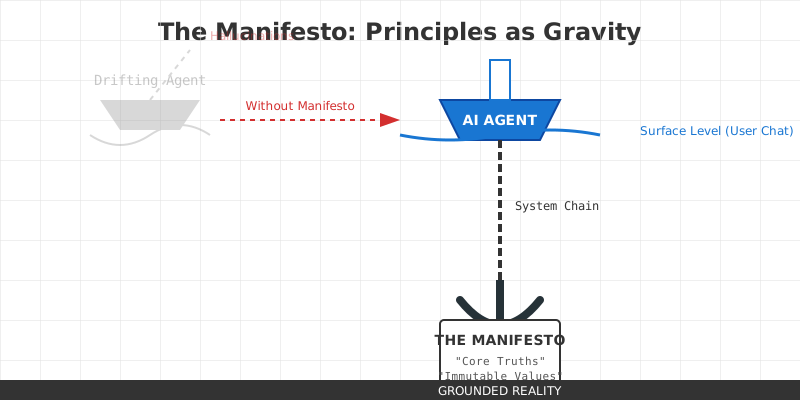
Because the AI operates on probabilistic patterns, it needs strong Strategic Guidance. In Vibe Coding, this takes the form of a Manifesto. A manifesto is a high-level set of principles for the project's design and behavior. It is the Sovereign instruction set that prevents the AI from defaulting to average, "safe" code.
If your manifesto states, "We prioritize extreme privacy and local-first data," the AI will proactively suggest local storage solutions over cloud databases. It will "weight" its suggestions toward your stated values. This is how you ensure Operational Alignment. Without a manifesto, the "vibe" becomes diluted, and the resulting software loses its Hardened Persona.
This is the ultimate evolution of Prompt Engineering. We aren't just prompting for a single response; we are Conditioning a System. We are creating a Feedback Loop where the machine's intelligence is constantly filtered through the human's ethical and aesthetic standards. This is the New Literacy of the machine age.
The Final Goal: Perfect Alignment
What is the Ultimate Vibe? It is software that works exactly as the user intended with minimal friction. It is the perfect Alignment between human desire and machine execution. When the lines in your mind manifest on the screen without the "translation error" of manual coding, you have achieved Vibe Mastery.
At the Rural Wisconsin dump, I used to find PCs that were "broken" simply because someone forgot to connect a single jumper. The logic was there, but the line was broken. Vibe Coding is the tool that connects every jumper. It allows us to reclaim the Grace of Creation. It allows us to build tools that serve others, protect privacy, and manifest beauty with the speed of thought.
As a follower of Jesus Christ, I see this as a way to better steward the time we've been given. We are no longer limited by what we can type; we are only limited by what we can Imagine and Direct. Technology is finally becoming the servant of the vision, rather than the master of the time.
Summary: Master the Intent, Master the Machine
Vibe Coding is not a shortcut; it is a Level Up. It requires you to think harder about Logic and Architecture because you can no longer hide behind the "busy work" of syntax. You must be clear. You must be technical. You must be sovereign.
Remember the core pillars: Use Semantic Description to set the stage. Use Iterative Sculpting to refine the form. Leverage AI-Integrated IDEs as your cockpit. And always, always start with a Manifesto.
The frontier is open. The machine is ready. What is the vibe of the world you want to build?
Let the intent lead. Let the patterns manifest. Let the lines connect.