The Creative Vacuum: Initialization as a System Failure
The most expensive state in any project is the Zero-Sum Initialization. The blank page isn't just a lack of content; it is a Vacuum of Energy that consumes the momentum of even the most experienced architects. In the traditional creative process, we often find ourselves stuck in Mental Loops, where our biological neural networks fire along the same well-worn paths, resulting in derivative or predictable outputs. This phenomenon is a form of Path-of-Least-Resistance Thinking, where the brain prioritizes energy conservation over Divergent Breakthroughs.
When you are faced with a complex problem—whether it is designing a new software architecture or drafting a mission-critical legal strategy—your biggest enemy is Friction. This is where Brainstorming with AI becomes a tactical necessity. By using a Large Language Model as a Sparring Partner, you are essentially injecting high-velocity, low-friction alternatives into your cognitive loop. The AI doesn't "do the thinking" for you; it acts as the Stochastic Catalyst that breaks the symmetry of your initial thoughts, allowing you to see patterns that were previously occluded by your own biases.
As someone with High-Functioning Autism, I view the creative process through the lens of Pattern Recognition. Creativity for me isn't about "intuition" in the mystical sense; it is about the ability to navigate a Multi-Dimensional Latent Space and find the relationships between disparate concepts. AI is the tool that allows me to navigate that space at scale. It transforms the Blank Page from a vacuum into a rich field of Probability Samples, where my job is no longer to "think of an idea," but to Curate the Truth.
Divergent Evolution: Expanding the Latent Space
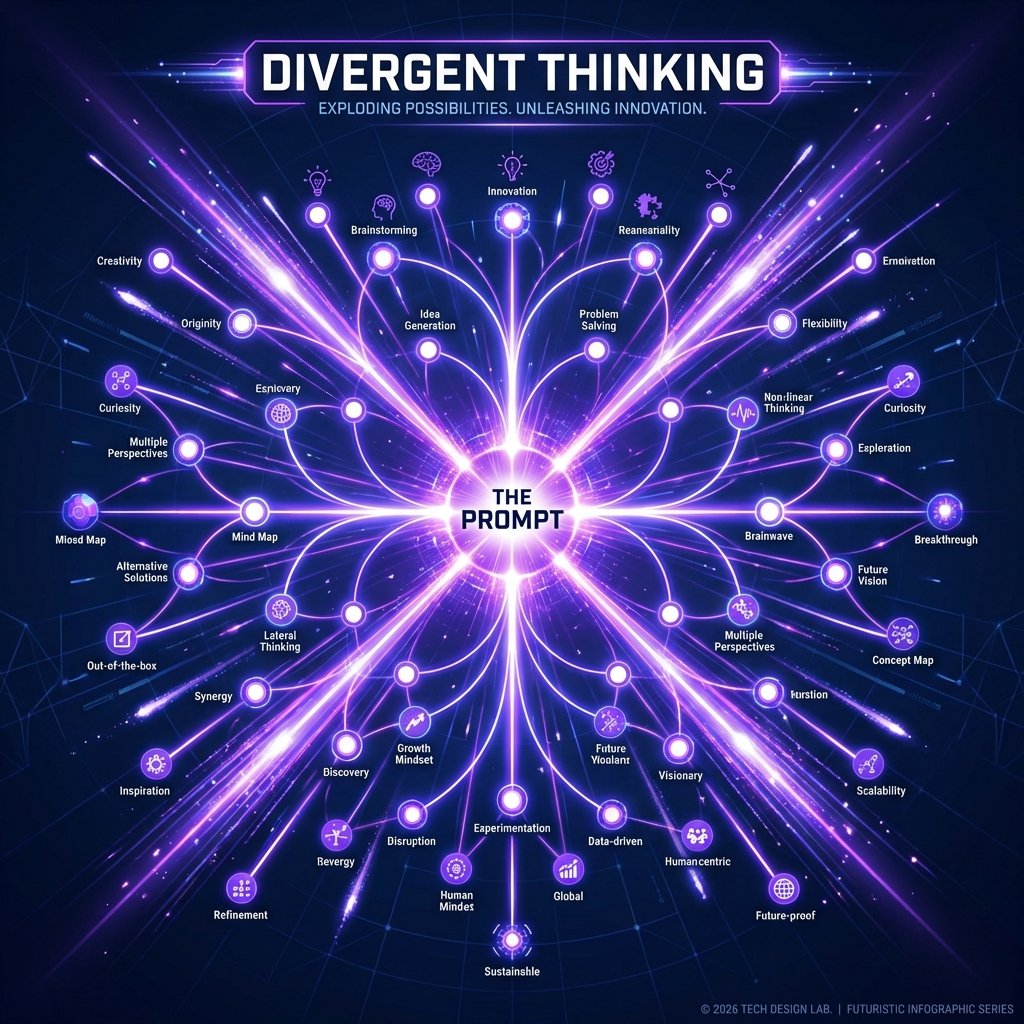
At its core, Brainstorming is about Divergent Thinking—the ability to generate a wide variety of unique solutions or ideas for a single problem. Most humans are naturally better at Convergent Thinking (narrowing down to one answer), especially under pressure. AI, however, thrives on Divergence. Because the math of a transformer model is probabilistic, you can use it to "explode" a single concept into 50, 100, or 1000 variations in seconds.
By adjusting parameters like Temperature during Inference, you can control the "creativity" or randomness of the model. High-temperature inference is particularly useful for Ideation, as it encourages the model to sample less-likely tokens, leading to more "unconventional" or even "weird" ideas. While these might seem like errors in a factual context, in a creative context, these Hallucinations serve as the raw material for innovation. They are the Creative Sparks that your human mind can then filter, refine, and ground into reality.
The Orchestrator's Divergence Protocol:
"Give me 20 radical alternatives for [Project X]. I want 5 that are logically sound, 5 that are ethically challenging, 5 that are technically impossible with today's hardware, and 5 that feel like they were written by a 22nd-century sci-fi novelist."
The AI Sparring Partner: Strategic Semantic Priming
To get the most out of an AI session, you must employ Semantic Priming—using a specific System Prompt or persona to influence the "flavor" of the ideas. If you ask for marketing ideas from "a generic AI," you will get generic "Outs." If you prime the model to act as a Direct-Response Copywriter from the 1920s who is suddenly teleported to the age of Agentic Workflows, the results will have a distinctive, high-authority edge.
This is a form of Persona Engineering. You aren't just giving the model a role; you are tightening its Latent Focus. By establishing these constraints early in the Mega-Prompt, you ensure that every idea generated is filtered through a specific set of world-models. This is how you bypass the "Average Output Trap." You use the engine's massive training data not as a general knowledge base, but as a Synthesis Engine for specific high-stakes perspectives.
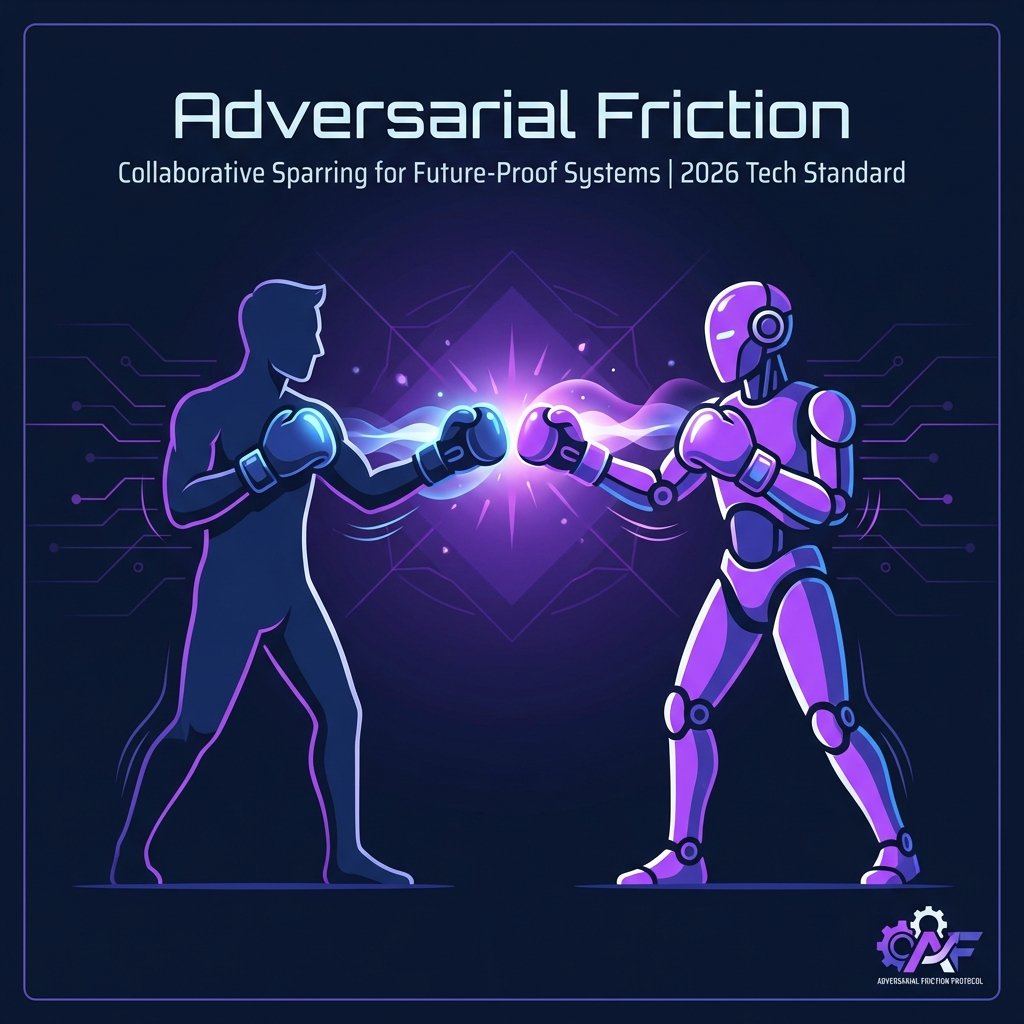
Think of the AI as an Expert Consultant that has read every book, paper, and forum post on your topic. When you use it as a Sparring Partner, you are engaging in a Socratic Loop where the model challenges your assumptions and provides the Adversarial Friction necessary to test the strength of your ideas. This is particularly effective for Technical Troubleshooting and Sovereign System Design.
Engineering Inspiration: The SCAMPER Framework

Creativity is often seen as a chaotic process, but the best ideation is highly structured. A framework I recommend exploring during an AI session is the SCAMPER framework. While often used in traditional industrial engineering, it becomes a literal force-multiplier when used as a Prompting Directive. It provides a systematic way to look at an existing project and "force" new ideas through seven different logic gates:
Substitute
Swap one component for another (e.g., using a local LLM instead of cloud).
Combine
Mix disparate features (e.g., AI synthesis plus decentralized storage).
Adapt
Borrow a logic pattern from a different industry (e.g., medical triage for IT support).
Modify
Magnify or minimize a core feature (e.g., a "zero-UI" interface for speed).
Put to Use
Find a radical new use case for your existing tool.
Eliminate
Remove features to achieve "Brutal Simplicity" and lower friction.
Reverse
Flip the "In" and "Out" (e.g., instead of user prompting AI, AI prompts user).
By asking an AI to "Apply a SCAMPER-style analysis to my current prototype," you are using the machine's ability to handle Combinatorial Logic. Humans struggle to keep all seven paths in mind simultaneously, but an AI can process them in a single Context Window, providing you with a Mind Map of possibilities that you can then explore using Iterative Refinement.
The "Yes, And..." Loop: Maintaining Creative Velocity
One of the common mistakes in Brainstorming is stopping mid-flow to critique an idea. This causes Cognitive Context Switching, where your brain moves from "Creative Mode" to "Analytical Mode," killing the momentum. To maintain Creative Velocity, I recommend borrowing the "Yes, And..." technique from improvisational theater.
When the AI generates an idea—even a "weird" or "impossible" one—don't tell it "No." Instead, reply with a Prompt Chain that starts with "Yes, and..." This signals to the model that you want to expand on the current Logic Branch rather than prune it. By building these Prompt Chains, you can reach deeper, more nuanced "Outs" that a single request would never achieve.
This is the difference between a Transactional Interaction and a Collaborative Architecture. In a transaction, you ask for a list and receive it. in a collaborative architecture, you are Vibe Coding the very fabric of the idea, moving iteratively until the Mental Model you carry in your mind is perfectly mirrored by the machine's output. This is how we overcome Writer's Block—we treat every "Out" not as a final answer, but as the next step in a recursive loop.
Case Study: Architecting the Antigravity IDE
When I first began deep-working within the Google Antigravity IDE—a high-authority fork of VS Code optimized for agentic orchestration—I wanted to push the limits of how I visualized my project architectures. I initiated a brainstorming session with Anthropic Claude, using a Density-Focused Context Window to map out the Ins and Outs of my local development environment.
I used the AI to help me reorganize my Logic Silos, searching for ways to substitute traditional manual file-management with more autonomous, pattern-based workflows. This led to the realization that the IDE isn't just a place to type code; it is a catalyst for Intent Visualization. We leveraged Mind Mapping techniques to bridge the gap between human thought and machine execution, resulting in the high-efficiency Glass Container workflow I use for all my projects today.
This process was a prime example of Exponential Leverage. By using AI to handle the Divergent Ideation of my system setup, I was able to transition to a fully optimized agentic workflow in hours rather than days. I acted as the Editor-in-Chief, selecting the most resonant patterns and using Vibe Coding to finalize the configuration.
Summary: The Selection Protocol
The goal of Brainstorming & Ideation is not just to generate "more" ideas; it is to find the One True Path. Your final responsibility as a Sovereign Creator is the Selection Protocol. AI can give you the quantity, but only a human, acting with Logical Integrity and Service to the Mission, can provide the Convergent Judgment to decide which idea is worth building.
As we move into the next module on Problem-Solving, remember that every problem started as an idea, and every solution starts with a spark. Use these tools as a Digital Force Multiplier. Build the pipes of your imagination so that the grace of God can flow through your work into the lives of others.
DON'T JUST BRAINSTORM • ARCHITECT REALITY